
Tehran at High Noon: Operation Epic Fury, the Demise of the Rules-Based Order, and the Dawn of the Interest-Based World

By Barry Appleton | March 1, 2026 Appleton’s Clause & Effect Substack
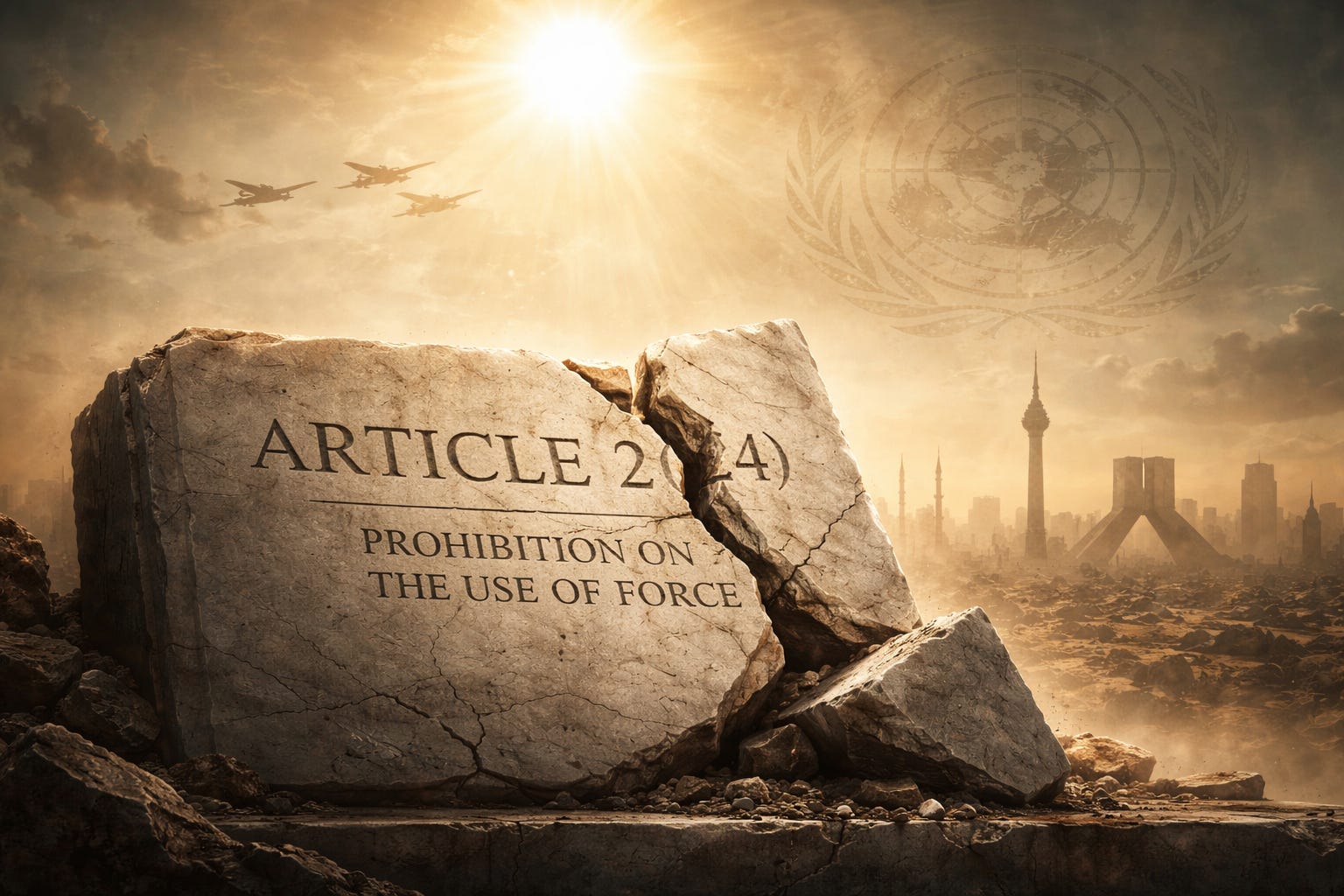
The post-1945 international legal order didn’t erode on this particular February morning. It was discarded.
The bombs fell on a Saturday morning in Tehran—in full daylight, while millions were heading to work and school. This was not a covert midnight operation or a crisis response to an imminent attack in progress. Dubbed “Operation Epic Fury, as the Pentagon has named it, was deliberate, weeks in the making, coordinated with Israeli intelligence across multiple senior planning sessions, and launched over the express objections of Congress, allied governments, and an Omani diplomat who had spent weeks shuttling between delegations convinced a deal was within reach.1 Within hours, Iran’s Supreme Leader was dead, civilians were confirmed killed, a girls’ elementary school lay in rubble, and Tehran’s international airport had gone dark.2
It was the third major act of force projection in eight weeks. The capture of Nicolás Maduro from Caracas on January 3, relabeled by the White House as an “extraterritorial law enforcement operation” rather than an act of war, was followed by intensifying economic and rhetorical coercion directed at Greenland—a NATO ally’s territory—and now this.
The pattern is no longer deniable: the administration is operationalizing a strategic doctrine that treats international legal constraints as optional rather than obligatory.3
This article addresses the international legal, moral, and structural dimensions of the events that have occurred. It does not content itself with the conventional critique—that the international law rules about the use of force were broken and nothing was done about it. The February 2026 Iran strikes expose something more fundamental: that a new doctrine of great power projection is being assembled in real time, that it contains genuine moral complexity that serious lawyers must reckon with honestly, and that the post-1945 international order is not eroding at the margins but being replaced at the center.
I. The Moral Complexity: Iran’s Genuine Sins
Serious international legal analysis requires intellectual honesty about what it is defending. The Iranian regime that was targeted on Saturday, February 28th, was not an innocent sovereign state minding its own affairs. It was among the most systemically dangerous and repressive governments in the contemporary international order, and that reality shapes the moral and legal calculus in ways that cannot be wished away.
Iran’s material support for designated terrorist organizations—Hamas, Hezbollah, and the Houthis—constitutes a sustained pattern of state-sponsored proxy violence that has killed thousands of civilians across the Middle East over decades. Under the Articles on State Responsibility for Internationally Wrongful Acts, Iran’s “effective control” over significant Hezbollah operations and its “directing or controlling” of Houthi attacks on commercial shipping create serious questions of state responsibility that cannot be resolved by reference to sovereignty alone.4
In the weeks before the strikes, the Iranian government’s response to its own people’s demands for dignity had been savage. The early 2026 protests—sparked by economic desperation and decades of political repression—were met with lethal force against peaceful demonstrators. Iran cut all internet access to the country on January 8, severing tens of thousands of protesters from the outside world and preventing the documentation of atrocities.5 This digital blackout—the weaponization of connectivity against a state’s own civilian population—was itself a form of warfare against civil society that existing international law lacks adequate tools to address.
Iran’s nuclear program, whatever the administration’s conflicting claims about its current state, represented a genuine proliferation risk of the highest order. Its ballistic missile development program has fundamentally destabilized the security environment of the Middle East. These are not fabrications or pretextual constructions. They are documented, established facts.6
I am indebted to my colleague, NYU Professor Robert Howse, who has challenged what he aptly calls “Charter Purism”—the reflexive invocation of Article 2(4) that treats the text as a talisman capable of resolving every moral question the real world presents. New York Law School’s Professor Ruti Teitel, whose extraordinary book Humanity’s Law traced the shift from state-centered to person-centered conceptions of international legal order, has shown us that human security norms have risen to a status equal to, and sometimes in tension with, territorial sovereignty.7
Simply shouting “Charter Article 2(4)” rings hollow when the target is a regime that has systematically violated the most foundational norms of international humanitarian law.
These are serious arguments. They deserve a serious answer—and no matter how much I grew up with a respect for the United Nation system, that answer can no longer be that the Charter is always right because it is the Charter.
But here is where the moral complexity collapses into legal incoherence: the fact that a regime is brutal does not render a massive, preemptive military strike conducted without Security Council authorization lawful. The International Criminal Court for the Former Yugoslavia (ICTY), in its Nikolić balancing test, asks whether the damage to international justice caused by allowing impunity is comparatively greater than the injury to state sovereignty. Even applying that framework generously, Operation Epic Fury does not pass. The strikes did not rescue civilians from imminent massacre. They decapitated a government while the Omani diplomat was still shuttling between delegations. The humanitarian rationale came after military planning was complete.
II. What the Law Actually Says—and Why It Matters
The prohibition on the use of force in international relations is not merely a technical rule. It is the foundational norm of the post-1945 international order, constructed in the shadow of two catastrophic world wars, by diplomats who had personally witnessed what happens when great powers convince themselves that their strategic objectives justify force against sovereign states. Article 2(4) of the United Nations Charter could not be clearer: member states must refrain from the threat or use of force against the territorial integrity or political independence of any state.
Iran did not attack the United States on February 28, 2026. Iran did not attack Israel in the days immediately preceding the strikes. The operations were not a response to an ongoing armed attack. They were preemptive, large-scale military strikes on a sovereign state while diplomatic negotiations were actively underway through the Omani channel. The United States will point to UN Charter Article 51—the self-defense exception. Article 51 permits individual or collective self-defense “if an armed attack occurs.” The International Court of Justice has consistently held, most directly in Nicaragua v. United States (1986) and Oil Platforms (2003), that Article 51 requires an actual armed attack, not a hypothetical future capability.8
The administration offered a more textured legal argument: U.S. intelligence had identified that Iran was actively considering strikes against American targets, which, combined with the closing window created by the Iranian nuclear and missile programs, satisfied the “last window of opportunity” test that Professor Michael Schmitt and others have identified as the most legally defensible interpretation of anticipatory self-defense.9 This argument is not frivolous. Professor Schmitt’s own analysis in June 2025 acknowledges that interpretive adaptation of the right of self-defense can be appropriate when significant changes in circumstance were not anticipated at the time the UN Charter was adopted.10
But even accepting the “last window” framework at its most generous, the administration’s legal position collapses under the weight of its own statements. The President announced just days before the strikes, at the State of the Union, that Iran’s nuclear program had already been “obliterated” in last summer’s operations. If the nuclear threat has already destroyed, the necessity predicate for anticipatory self-defense does not exist. A “last window” argument requires a closing window—not one that has already been closed and reported as such by the President himself.
What is more, the administration’s stated rationale shifted between objectives in ways that are legally incoherent. Trump announced the strikes were to eliminate “imminent threats.” He simultaneously called on Iranians to overthrow their government and threatened Iranian Revolutionary Guard members with “certain death” if they did not lay down their arms. Israeli PM Netanyahu explicitly framed the operation as creating conditions for regime change. You cannot invoke self-defense while simultaneously declaring regime change as your objective.11 These are fundamentally different legal justifications. International law permits neither in the circumstances presented here.
III. The Caracas-to-Tehran Pipeline: A New Doctrine of Regime Modification
Operation Epic Fury cannot be understood in isolation. It is the third and most consequential act in a strategic sequence that began with Operation Absolute Resolve in Caracas on January 3, 2026, and has continued through sustained coercive pressure on Greenland. Together, these actions reveal not improvisation but doctrine.
In an earlier Substack blog on Venezuela, I analyzed how the administration reframed military invasion as “extraterritorial law enforcement,” relying on the 1989 Barr Memorandum’s contested claim that the President possesses inherent constitutional authority to order actions that contravene international law, including Article 2(4) of the UN Charter.12 The characterization was legally threadbare—Professor Mary Ellen O’Connell of Notre Dame Law School called it precisely what it was: an unlawful detention—but it served a doctrinal purpose. It created the precedent that military operations against sovereign states can be reframed as something other than uses of force, thereby circumventing the Charter’s authorization requirements.
The November 2025 National Security Strategy’s “Trump Corollary to the Monroe Doctrine” provides the strategic architecture for this sequence.13 The document declares that the United States “will deny non-Hemispheric competitors the ability to position forces or other threatening capabilities, or to own or control strategically vital assets, in our Hemisphere,” and explicitly rejects what it characterizes as “sovereignty-sapping” international institutions and treaty commitments. In the Middle East, the analogous framework extends to the administration’s declared determination to prevent Iranian nuclear acquisition and ballistic missile development—objectives that, by their nature, may require repeated military action rather than a single definitive strike.
Greenland sits in a different category—the coercion there has remained below the threshold of armed force—but it is part of the same pattern. When the United States threatens tariffs against a NATO ally in response to its deployment of troops to defend its own territory, and characterizes a sovereign Danish territory as a “national security necessity” for acquisition, it is signaling that the rules of the international system apply to others, not to itself.14 The message received in capitals around the world is precisely the one intended: American strategic preferences now take precedence over international legal constraints.
The Caracas-to-Tehran pipeline also reveals what I would call a doctrine of “regime modification” rather than regime change. In Venezuela, the administration captured Maduro but continued to work with the underlying state apparatus—the same machinery that committed the human rights abuses that provided the humanitarian rationale for the operation. In Iran, the Trump and Netanyahu governments have called on the Iranian people to rise up and take control of their government, while providing no mechanism for them to do so and no plan for the transition that would follow. The humanitarian rationale becomes window dressing when the result is not the protection of civilians but the installation of a more compliant operating environment. If the goal is genuinely to end human rights abuses, why partner with the machinery that committed them?
IV. IHL and the Architecture of the Strike
Even setting aside the jus ad bellum—the law governing whether force may be used—the conduct of Operation Epic Fury raises profound questions under jus in bello, the law governing how force is used once armed conflict has begun. The administration cannot both claim that the operation was legitimate and evade scrutiny of its conduct.
The deliberate targeting of Iran’s Supreme Leader and dozens of senior officials in simultaneous strikes raises questions that will occupy war crimes lawyers for years. Ayatollah Khamenei held dual status as both the civilian head of government and the commander-in-chief of Iran’s military. His targeting may be defensible under IHL’s principle of distinction if he was directly participating in the direction of hostilities at the time of the strike.15 But the reported simultaneous targeting of forty officials—and the confirmed destruction of a girls’ elementary school in Minab with heavy civilian casualties—demands independent investigation. The principle of proportionality prohibits attacks where the anticipated civilian harm is excessive relative to the anticipated military advantage. Strikes that killed civilians in the first hours of a daylight urban campaign must be subjected to rigorous scrutiny.
There is a harder question that the conventional IHL framework was not designed to ask: how were these targets selected? Modern operations at the scale and complexity of Epic Fury do not involve generals poring over maps. They involve AI-assisted targeting systems, signals intelligence processed by algorithms, pattern-of-life analyses generated by machine learning, and kill lists compiled by systems that no single human reviews in real time. If an algorithm misclassified a school as a military objective—or if a targeting system failed to apply an adequate proportionality analysis—the IHL accountability framework has no mechanism to address it. There is no treaty governing AI-assisted targeting. The International Committee of the Red Cross’s calls for new rules on autonomous weapons systems have produced years of expert meetings and no binding instrument.16
The killing of state officials during active diplomatic negotiations adds a dimension IHL was never designed to address. The Omani foreign minister was in Washington on the eve of the strikes arguing against military action. Iran had reportedly agreed, at the most recent round of talks, never to stockpile enriched uranium above specified limits.17 The strikes came not despite the diplomacy but, at least operationally, through it—the negotiating process provided intelligence-gathering opportunities and political cover for operational preparation. This is not merely an ethical failure; it has structural consequences for the future of mediation in international disputes.
V. The Death of Good-Faith Diplomacy
The Vienna Convention on the Law of Treaties enshrines the principle of pacta sunt servanda and good faith in international dealings. The UN Charter itself, in Article 2(2), requires all members to fulfill their obligations in good faith. The principle extends beyond concluded treaties to the conduct of diplomatic negotiations: the international institution of good-faith diplomacy is itself a cornerstone of the system that allows conflicts to be resolved short of armed force.
What happened in Muscat over the past weeks was not a failed negotiation followed by a decision to use force. It was a diplomatic process conducted simultaneously with military preparation and planning, in circumstances that suggest the negotiations were understood by at least one party primarily as a source of intelligence and political cover rather than as a genuine attempt to reach agreement. Whether Iran’s final negotiating positions—retaining thousands of advanced centrifuges and 20% enrichment—were genuinely irreconcilable with American requirements, or whether the negotiations were never intended to succeed, is a question that deserves honest scrutiny.18
The lesson that other states will draw from this experience is not that diplomacy failed—it is that agreeing to negotiate with the United States while it prepares military action against you may accelerate rather than defer that action. The negotiating table provides intelligence on your positions, creates a period of political stability that enables operational preparation, and then is used to claim that diplomatic options were exhausted when the decision to use force had already been made. If that lesson is internalized, the next crisis will produce no negotiations at all. The international institution of good-faith diplomacy cannot survive systematic weaponization by great powers.
VI. Digital Warfare and the Gaps in International Law
Operation Epic Fury was not conducted through kinetic force alone. In parallel with the strikes, Israel conducted broad cyberattacks that targeted Iranian media and phone applications with messages calling on Iranians to rise up against their government. Israel hacked a widely used Muslim prayer-time tracking app to send messages calling on Iran’s armed forces to defect.19 State news agency IRNA was compromised. Iran’s state television was hacked. The Israeli military and intelligence services were simultaneously conducting kinetic strikes and information operations designed to destabilize the Iranian government’s internal communications.
International law has no adequate framework for this. The laws of armed conflict apply to armed conflict between states—they were not designed to address the integrated deployment of cyberattacks, information operations, and kinetic strikes as a unified campaign. The International Covenant on Civil and Political Rights protects freedom of expression, but its enforcement mechanisms are toothless against a state using digital infrastructure as a weapon. The Tallinn Manual 2.0’s analysis of cyber operations under existing international law represents the state of scholarly effort, but it remains non-binding guidance without treaty authority.
What is more deeply troubling is that digital operations shape the factual predicate on which legal arguments rest. Iran’s internet blackout in January distorted the international community’s understanding of what was happening inside the country—casualty figures were unreliable, the scale of the crackdown was unclear, and the humanitarian justification for intervention was being constructed on incomplete information. Cyber warfare does not just destroy infrastructure. It destroys the epistemological (informational) foundation on which legal and political judgment depends. International law has no answer to this.
VII. The Institutional Entropy
The UN Security Council was, predictably, paralyzed. Russia and China would veto any resolution condemning the strikes. The United States would veto any resolution restricting them. This is not new—Security Council paralysis during great power conflicts is a structural feature of the institution, not a malfunction. But the Iran strikes bring into sharp relief a question the international community has refused to confront directly: what happens when the collective security system is not merely slow or imperfect, but categorically incapable of restraining the state that is both its most powerful member and its most consequential norm-violator?20
The answer, which international law provides today, is: nothing consequential. There is no mechanism for removing a permanent member’s veto. The General Assembly’s “Uniting for Peace” resolution provides a political forum but not a legal remedy. The International Court of Justice can issue advisory opinions and judgments, but enforcement depends on Security Council referral, which the United States would block. The International Criminal Court has no jurisdiction over U.S. nationals, and even if it did, the political will to prosecute does not exist in the current circumstances.
This is not a legal gap that can be closed by better drafting. It is a structural deficiency in the architecture of international governance. The post-1945 order assumed that great powers would be sufficiently deterred by mutual vulnerability and mutual interest not to engage in the conduct that is now being normalized. Those assumptions no longer hold—not because the world has changed in ways the drafters could not have anticipated, but because the United States has made a deliberate doctrinal choice to treat international legal constraints as optional.
VIII. The Eichmann Point and the Limits of Outcome-Based Justification
There is an uncomfortable intellectual tradition that must be engaged honestly. Israel’s 1960 abduction of Adolf Eichmann from Argentina was unquestionably a violation of Argentine sovereignty. Yet history has largely—though not universally—vindicated the result. Eichmann was tried, convicted, and executed for crimes of unimaginable magnitude. The violation of international law produced a form of accountability that the international system had failed to deliver. Does something similar apply here?
The answer requires distinguishing between what might be defensible in retrospect and what can be endorsed as a general rule of international conduct. If every state becomes its own judge and jury—if every government that believes it has a sufficient humanitarian or security grievance is entitled to strike first and argue legality later—the international system ceases to function as a system. It becomes a state of nature with better-dressed participants.
The Eichmann precedent was a singular event involving crimes against humanity of extraordinary historical weight, and even it was broadly criticized by international lawyers at the time and has never been accepted as establishing a general right of extraterritorial abduction. Operation Epic Fury is not analogous. The Iranian regime’s brutality, real as it is, does not reach the threshold of the Holocaust with millions of deaths. The strikes were not a precision operation to bring a specific criminal to justice. They killed civilians in the first hours, destroyed a girls’ elementary school (killing many more), and have produced a period of dangerous regional instability whose ultimate human costs are not yet calculable.
History has a way of vindicating an illegal process when the outcome serves humanity’s interests. But it does not follow that every actor who claims a humanitarian outcome is entitled to proceed.
The critical question—which the Eichmann case left unanswered because no general doctrine was ever meant to follow from it—is who decides. If the decision is made unilaterally, without accountability, by the most powerful state in the world, what has been created is not a humanitarian legal norm. It is a license for abuse.
IX. The Dawn of the Interest-Based Order
I have spent my lifetime defending the rule of law and the UN Charter. However, it' is time to put sentiment aside. We are entering what I would call a period of institutional entropy. The rules-based international order is not collapsing dramatically—it is degrading gradually, norm by norm, each violation establishing a precedent that makes the next one more defensible. The prohibition on the use of force means less today than it did in 2003, which meant less than it did in 1991.
Each cycle of impunity erodes the norm further.
What is replacing it is something that might be called an interest-based order. In this order, international rules apply when powerful states find them convenient to do so and yield when they do not. National security exceptions—GATT Article XXI, UN Charter Article 51, the inherent right of self-defense—become self-judging tools rather than legally constrained exceptions. Great powers engage in diplomatic processes not to reach agreements but to manage the political optics of decisions they have already made. Doctrines don’t stay in Panama, Caracas, or Tehran. They travel.
The international lawyer’s challenge in this environment is not to pretend that the legal framework is adequate to the world as it exists. It is to be honest about what has been lost and what must be built—to resist the temptation of performing compliance with a system that has ceased to function as a system.
Addressing the three-layered crisis of contemporary international law—the normative erosion of foundational prohibitions, the jurisdictional gaps in digital and algorithmic domains, and the structural incapacity of international institutions—is the work of a generation. But the starting point is honesty. The legal framework we have was not designed for the world we now inhabit. And invoking it without acknowledging its limits does not uphold the rule of law. It merely performs the gesture of compliance while the substance drains away.
“Pacta sunt servanda. Agreements must be kept. The smoke rising over Tehran suggests a different doctrine now prevails.”
Nicolás Maduro was a brutal authoritarian who subverted Venezuelan democracy and presided over a humanitarian catastrophe. Ali Khamenei was a theocratic dictator who funded terrorist organizations and massacred his own people. These facts are true. They do not transform what has happened into something lawful. They make it morally complicated—which is precisely why international law exists. Not to protect the innocent from the guilty, but to constrain the powerful from becoming the only judges of who is guilty.
Iran is burning. The law watched. And the question that will define the next decade of international order is whether anyone will have the will and the institutional capacity to rebuild what has been destroyed—or whether we will simply learn to call the rubble by a different name.
Barry Appleton is a Distinguished Senior Fellow and Co-Director of the Center for International Law at New York Law School, Managing Partner at Appleton & Associates International Lawyers LP, and a Fellow and Scholar at the Balsillie School of International Affairs. He has over thirty-five years of experience in international law, including involvement in the original NAFTA negotiations and international investment arbitration. His earlier analysis of the Venezuela operation, “What the Venezuela Operation Means for International Law,” was published on January 3, 2026, on Appleton’s Clause & Effect Substack.
Endnotes
Dov Lieber, “Why the U.S. and Israel Struck When They Did: A Chance to Kill Iran’s Leaders,” Wall Street Journal, March 1, 2026, https://www.wsj.com/world/middle-east/why-the-u-s-and-israel-struck-iran-when-they-did-a-chance-to-kill-its-leaders-b0dbbc88. Israeli intelligence identified three concurrent senior leadership meetings as the operational trigger for the daylight strikes. By evening, approximately 200 Israeli fighters had struck close to 500 targets in the largest single air campaign in Israel’s history.
Peter Baker, “Trump, the Self-Declared Peace President, Goes to War Seeking Regime Change,” New York Times, February 28, 2026, https://www.nytimes.com/2026/02/28/us/politics/trump-peace-president-war.html. Civilian casualty figures and damage to civilian infrastructure including the girls’ school in Minab were reported by multiple news agencies within hours of the strikes commencing.
Barry Appleton, “What the Venezuela Operation Means for International Law,” Appleton’s Clause & Effect, January 3, 2026, https://barryappleton.substack.com/p/when-invasion-becomes-policing-what. On the Greenland coercion, see reports of U.S. tariff threats against Denmark and European allies following Danish-led Arctic exercises: Robert Gillies, “Canada Weighs Plans to Send Soldiers to Greenland as Show of NATO Solidarity,” Globe and Mail, January 19, 2026.
International Law Commission, Articles on the Responsibility of States for Internationally Wrongful Acts, art. 8 and 16 (2001) Art, 16 (providing that a state that aids or assists another state in the commission of an internationally wrongful act is internationally responsible if it does so with knowledge of the circumstances) applies to aiding and assisting (weapons supply, financing), while Article 8's effective control/direction standard applies to operational conduct of proxy forces. Both theories are available, but they are not the same. On the “effective control” standard, see Military and Paramilitary Activities in and Against Nicaragua (Nicaragua v. United States), Merits, 1986 ICJ Rep. 14, ¶¶ 109–115 (June 27). See also UN Security Council, reports on Iran’s support for Hezbollah, Hamas, and the Houthis, S/2024/257 (April 2024),
NetBlocks, “Iran Restricts Internet Amid Protests,” January 8, 2026, See also Amnesty International, “Iran: Authorities Must End Violent Crackdown on Protesters and Ensure Accountability,” January 2026, The digital blackout severed protesters from international documentation mechanisms and outside communications at a critical juncture.
International Atomic Energy Agency, “NPT Safeguards Agreement with the Islamic Republic of Iran,” GOV/2025/48, November 2025, https://www.iaea.org/publications/documents/board/2025/gov2025-48. The IAEA Board of Governors had found Iran in non-compliance with its NPT safeguards obligations. On the ballistic missile program, see UN Panel of Experts on Iran, Final Report, S/2025/300.
Ruti Teitel, Humanity’s Law (Oxford: Oxford University Press, 2011), 3–11, 165–70. Teitel’s central thesis is that “the normative foundations of the international legal order have shifted from an emphasis on state security—that is, security as defined by borders, statehood, territory, and so on—to a focus on human security: the security of persons and peoples.” She traces this shift across three intersecting legal regimes—international humanitarian law, human rights law, and international criminal justice—arguing that together they constitute a “humanity law” framework that “reshapes the discourse of international relations” and increasingly displaces the state as the primary subject of international legal protection. Crucially for present purposes, Teitel does not argue that sovereignty disappears; rather, she documents that it is “losing its traditional status of primacy in the legal ordering that governs matters that occur beyond the level of the individual state.” The ICTY gave authoritative institutional voice to this shift in Prosecutor v. Duško Tadić, IT-94-1-A (Int’l Crim. Trib. for the Former Yugoslavia July 15, 1999), holding that “a state-sovereignty-oriented approach ha[s] been gradually supplanted by a human-being-oriented approach.” In Chapter 7, Teitel further identifies an “interpretive turn” by which humanity law is propagated not through imposition from above but through the reinterpretation of existing legal norms by domestic courts, international tribunals, and political actors—a dynamic directly relevant to the question of whether the humanitarian rationale invoked for Operation Epic Fury constitutes a cognizable legal justification or a post-hoc interpretive claim in search of doctrinal support.
U.N. Charter art. 51 (“Nothing in the present Charter shall impair the inherent right of individual or collective self-defence if an armed attack occurs against a Member of the United Nations.”); Military and Paramilitary Activities (Nicaragua v. United States), 1986 ICJ Rep. at ¶¶ 176–201; Oil Platforms (Iran v. United States), Merits, 2003 ICJ Rep. 161, ¶ 51 (Nov. 6) (requiring “a reasonable conclusion that [the platform] was a military objective” before force could be justified in self-defense).
Michael N. Schmitt, “Interpreting the Law of Self-Defense,” Articles of War (Lieber Institute, West Point), June 27, 2025, https://lieber.westpoint.edu/interpreting-law-self-defense. The “last window of opportunity” test, as Schmitt elaborates, requires that the putative attacker wield the capability to carry out an anticipated armed attack, intend to mount it, and that the last window to defend effectively is about to close. All three criteria must be satisfied.
Ibid. Schmitt notes that interpretive adaptation of international law rules is appropriate “when there is a significant change in circumstance that was not anticipated at the time the UN Charter was adopted,” but that States must act in good faith, consistently with the object and purpose of the rule, and must satisfy the “straight face test.” The administration’s simultaneously announced regime change objectives complicate the good faith requirement materially.
Baker, supra note 2. Baker documents that Trump’s stated rationale evolved from “imminent threat” elimination to explicit advocacy for regime change over the course of a single night. Netanyahu’s public statements framing the operation as creating conditions for a different Iranian government are referenced in Lieber, supra note 1. The ICJ’s analysis of mixed-motive operations in Oil Platforms is relevant: where a stated defensive purpose is contradicted by evidence of other objectives, the legal justification is substantially undermined. 2003 ICJ Rep. at ¶ 64–67.
Appleton, “What the Venezuela Operation Means for International Law,” supra note 3. The Barr Memorandum is: Authority of the Fed. Bureau of Investigation to Override Int’l Law in Extraterritorial Law Enf’t Activities, 13 Op. O.L.C. 163 (1989). On the Barr Memo’s claim that the President may override “unexecuted treaties,” including Article 2(4), see Ryan Goodman, “Maduro Capture Operation and the President’s Duty to Faithfully Execute U.N. Charter,” Just Security, January 3, 2026,
White House, National Security Strategy of the United States of America 19 (Nov. 2025) [hereinafter 2025 NSS] (announcing a “Trump Corollary to the Monroe Doctrine” and committing to deny non-hemispheric competitors the ability to position forces or control strategically vital assets in the Western Hemisphere). The 2025 NSS explicitly characterizes multilateral treaty institutions as “sovereignty-sapping.”
On Greenland, see Barry Appleton, “A Made-in-Canada National Security Framework,” Appleton’s Clause & Effect, January 2026 (“American interest in Greenland is driven by critical minerals, strategic positioning, and concern about Chinese and Russian Arctic activity”). The Greenland situation illustrates that economic coercion and military threats can constitute forms of pressure on sovereignty that existing international law addresses imperfectly even when they fall short of armed force. See also UN Charter art. 2, ¶ 4 (prohibiting threats of force as well as its use).
The targeting of heads of state and senior government officials under IHL requires that the individual directly participate in hostilities or qualify as a military objective. On the dual-status analysis applicable to Khamenei as both civilian leader and military commander-in-chief, see Michael N. Schmitt, “Targeting and International Humanitarian Law,” in International Humanitarian Law: A Comprehensive Introduction (ICRC, 2d ed. 2019). The principle of proportionality is codified in Additional Protocol I to the Geneva Conventions, arts. 51(5)(b), 57(2)(a)(iii) (1977). On the obligation to take all feasible precautions to avoid civilian harm, see art. 57.
This issue of human vs. autonomous AI review of weapons is one of the foundational disputes between Anthropic, the maker of Claude, and the U.S. Department of War.
Lieber, supra note 1, reporting that Iran’s most recent proposal "would have left Iran with thousands of advanced centrifuges and permitted Iran to enrich uranium as much as 20%—far in excess of the initial caps on Iran's nuclear program under the 2015 nuclear deal." The U.S. characterized the Iranian position as "not anywhere close" to acceptable. The Omani foreign minister was physically present in Washington lobbying against the strikes on the eve of their launch. On the principle of good faith in international negotiations, see Vienna Convention on the Law of Treaties, arts. 26, 31(1), May 23, 1969, 1155 U.N.T.S. 331.
Baker, supra note 2. Charles Kupperman, former deputy national security adviser, is quoted: “The diplomatic effort to engage Iran was never going to yield the results that Trump sought. Pure Kabuki theater.” The U.S. position demanded complete dismantlement of Iran’s nuclear facilities, surrender of its uranium stockpile, and abandonment of enrichment—conditions Iran had rejected as tantamount to unconditional surrender. Whether negotiations conducted from this position could constitute good-faith diplomacy in the Vienna Convention sense is a serious question.
Lieber, supra note 1 (reporting that Israel hacked a widely-used Muslim prayer-time tracking application to send messages calling on Iran’s armed forces to defect and informing the civilian population that “help has arrived,” and that state news agency IRNA was also compromised). On the applicable international legal framework, see Tallinn Manual 2.0 on the International Law Applicable to Cyber Operations (Cambridge University Press, 2017), https://ccdcoe.org/research/tallinn-manual/. Rules 69–78 address cyber operations as part of hostilities under IHL, but do not resolve the accountability gap for AI-assisted or algorithmically directed operations.
On Security Council paralysis as a structural feature, see Thomas M. Franck, Recourse to Force: State Action Against Threats and Armed Attacks 1–20 (Cambridge University Press, 2002). The General Assembly’s Uniting for Peace mechanism, GA Res. 377(V), Nov. 3, 1950, provides a political forum when the Security Council is paralyzed, but generates only recommendations, not binding resolutions. On ICC jurisdiction, the United States is not a party to the Rome Statute (Rome Statute of the International Criminal Court, July 17, 1998, 2187 U.N.T.S. 90, https://www.icc-cpi.int/resource-library/documents/rs-eng.pdf), and the complementarity principle further limits the Court’s practical reach over the nationals of non-party states.