
When Invasion Becomes Policing: What the Venezuela Operation Means for International Law
The Death of Article 2(4) and the Collapse of the Post-1945 Legal Order

Appleton’s Clause & Effect Substack Blog | January 3, 2026
I. Introduction: The Caracas Dawn
In the early hours of January 3, 2026, the United States conducted what President Trump characterized as a “large scale strike” against Venezuela, culminating in the capture and extraction of President Nicolás Maduro and his wife, Cilia Flores.1 The operation—dubbed “Operation Absolute Resolve”—employed overwhelming military force, including airstrikes on military installations in and around Caracas, to execute what the administration characterizes as a law enforcement action.
This characterization demands scrutiny. Senator Tom Cotton defended the absence of congressional notification by drawing a domestic analogy: “Congress isn’t notified when the FBI is going to arrest a drug trafficker or a cybercriminal here in the United States.”2 Secretary of State Marco Rubio similarly framed the military operation as designed to “protect and defend those executing the arrest warrant.” The legal architecture undergirding this position reportedly rests upon a controversial 1989 Office of Legal Counsel (OLC) memorandum—the so-called “Barr Memo”—which purports to authorize presidential action in contravention of international law, including Article 2(4) of the United Nations Charter.3
The implications extend far beyond Caracas. President Trump announced that the United States would “run” Venezuela “until such time as we can do a safe, proper and judicious transition,” and that American companies would “spend billions” to “fix the oil infrastructure.”4 The explicit fusion of military intervention with resource extraction confirms what Maduro long claimed: that Washington’s ultimate objective is control of Venezuela’s oil reserves—the largest in the world.
For U.S. trading partners in the America, these developments should command immediate attention. The legal doctrines being deployed in Venezuela—the claimed authority to override treaty obligations, the characterization of military action as law enforcement, the explicit linkage of intervention to resource extraction—operate against the backdrop of the November 2025 National Security Strategy’s “Trump Corollary” to the Monroe Doctrine5 and the looming USMCA trade review.6 If the United States can reframe military invasion as “policing” to circumvent treaty constraints today, what protections truly exist for national sovereignty for the neighbors tomorrow?
II. Article 2(4) Under Siege: The Legal Characterization Problem
The post-1945 international legal order rests upon a foundational prohibition. Article 2(4) of the United Nations Charter provides that “[a]ll Members shall refrain in their international relations from the threat or use of force against the territorial integrity or political independence of any state.”7 Short of Security Council authorization under Chapter VII, or the inherent right of self-defense recognized in Article 51, force is prohibited.
This author has been thinking about Charter Article 2(4) for more than three decades since I wrote my thesis on this very topic. While events can always strain the Charter, the administration’s legal theory seeks to circumvent its Article 2(4) prohibition entirely by recategorizing the Venezuela operation as something other than the “use of force” within the meaning of international law. Instead, it is framed as extraterritorial law enforcement—the execution of a criminal indictment that happens to require military support. This reframing serves multiple doctrinal purposes: it obviates the need for Security Council authorization; it sidesteps Congressional war powers notification requirements; and it potentially avoids the constraints of international humanitarian law applicable to armed conflict.
Professor Marc Weller, Director of the International Law Program at Chatham House, offered a succinct assessment: “International law prohibits the use of force as a means of national policy. Short of a UN Chapter VII mandate, force is only available in response to an armed attack or possibly to rescue a population under imminent threat of extermination. Clearly, none of these requirements are fulfilled by the armed operation against Venezuela.”8
The administration’s claim that the operation was justified by the need to suppress narcotics trafficking or that the Maduro government constituted “a criminal enterprise” offers no recognized legal basis for military intervention. As Notre Dame Law School’s Professor Mary Ellen O’Connell observed: “If you detain someone unlawfully, if you take someone into your custody, and you do not have the legal right to do that, then what else would you call it? . . . The United Nations Charter makes it very clear that there are very few times when a country has the right to carry out military force on the territory of another country.”9
III. The Override Doctrine: From Shadow Law to State Practice
A. The Barr Memo’s Core Claims
The legal architecture reportedly underlying the Venezuela operation traces to the June 1989 Office of Legal Counsel opinion signed by then-Assistant Attorney General William Barr. The memo concluded that “the President, acting through the Attorney General, has inherent constitutional authority to order the FBI to investigate and arrest individuals in a manner that departs from international law,” including “Article 2(4) of the U.N. Charter and other unexecuted treaties.”10
The memo’s treatment of the UN Charter spans only four paragraphs. Its argument proceeds in two steps: first, that Article 2(4) is “non-self-executing” in the sense that courts cannot enforce it absent implementing legislation11; and second, that because the provision is “non-self-executing,” it does not bind the Executive as a matter of domestic law.
This reasoning conflates two analytically distinct categories. Category A encompasses treaty provisions that are “non-self-executing” in the sense that they have not “become a rule for the Court” to enforce in the absence of implementing legislation. Category B encompasses treaty provisions that are “not legally binding on the political branches.” The Barr Memo treats these categories as coterminous. They are not.
B. The Non-Sequitur: Self-Execution and Executive Obligation
The Restatement (Fourth) of Foreign Relations Law directly addresses this conflation: “A treaty’s lack of judicial enforceability is not inconsistent with a status of ‘Law of the Land’ under the Supremacy Clause. Constitutional and statutory provisions—also ‘supreme Law of the Land’—can also be non-self-executing in this sense.”12 Many federal laws provide no private cause of action yet remain binding on the Executive. The distinction between judicial enforceability and executive obligation is fundamental.
Professor Louis Henkin offered the canonical statement: “Whether a treaty is self-executing or not, it is legally binding on the United States. Whether it is self-executing or not, it is supreme law of the land. If it is not self-executing, Marshall said, it is not ‘a rule for the Court’; he did not suggest that it is not law for the President or for Congress.”13
The Take Care Clause reinforces this understanding. Article II, Section 3 of the Constitution provides that the President “shall take Care that the Laws be faithfully executed.”14 The Supremacy Clause makes “all Treaties made, or which shall be made, under the Authority of the United States . . . the supreme Law of the Land.”[15] 15The Senate Foreign Relations Committee stated unequivocally in 2008: “In accordance with the Constitution, all treaties—whether self-executing or not—are the supreme law of the land, and the President shall take care that they be faithfully executed.”16
C. The Historical Record and Treaty-Maker Intent
The Barr Memo’s analysis fails to engage the historical record of Charter ratification. Secretary of State Edward Stettinius’s Letter to President Truman—which featured prominently in Senate ratification discussions—identified Article 2(4) as among the Charter provisions that “are binding on the Members” and that “Members accept as binding.”17 Hans Kelsen, in his foundational treatise, identified Article 2(4) as one of the two provisions constituting “the main obligations of the Members.”18
As Professor Brian Finucane demonstrated in his exhaustive examination, “[t]hose involved in the drafting and ratification of the U.N. Charter who considered the matter took the position that the Charter would be a ‘Law’ within the meaning of the Take Care Clause.”19 The Truman administration invoked this understanding precisely in justifying U.S. involvement in Korea.
This is not a difficult question. The Restatement says so. Henkin says so. The Senate Foreign Relations Committee says so. The treatymakers themselves said so. The Barr Memo’s contrary conclusion is not a defensible minority view—it is more like a non-sequitur dressed in legal citation
A credible OLC opinion addressing Article 2(4)’s domestic legal status would have grappled with these sources. The Barr Memo did not. Its four-paragraph treatment reaches a radical conclusion—that the President may lawfully order actions that violate the UN Charter’s prohibition on the use of force—without engaging the strongest contrary authority. As Professor Ryan Goodman observed, the memo constitutes a “loaded gun” that has “remained around” without implementation until now.20
D. The Judicial Gap: Precedent Without Validation
The Barr Memo’s conclusions have never been judicially tested. This is not because courts have upheld the Executive’s authority to override Article 2(4), but because the doctrine operates in a jurisdictional gap that courts have declined to close.
The Panama invasion of December 1989—occurring just six months after the Barr Memo issued—provided the first operational application of the override doctrine. General Noriega, captured following a military invasion that killed hundreds of Panamanian civilians, challenged the court’s jurisdiction on grounds that the invasion violated international law and was “shocking to the conscience.”21 The Southern District of Florida declined to dismiss, but notably did not rule on whether the President possessed authority to override Article 2(4). Instead, Judge Hoeveler reasoned that “any ‘remedy’ would necessarily be directed at the consequences and effects of armed conflict rather than at the prosecution”—a jurisdictional sidestep that left the underlying legal theory unexamined.22
Two years later, the Supreme Court extended this judicial abdication in United States v. Alvarez-Machain. The Court held that forcible abduction from Mexico did not divest U.S. courts of jurisdiction, even where the abduction violated the purpose of an extradition treaty.23 The Ker-Frisbie doctrine—that courts may exercise jurisdiction regardless of how a defendant’s presence was obtained—effectively immunizes executive action from judicial review. International law violations may occur, but courts will provide no remedy.24
The Department of Justice has reinforced this gap by conspicuously avoiding reliance on the Barr Memo’s conclusions in court proceedings. When Noriega asserted POW status under the Geneva Conventions, the government argued the merits without invoking the memo’s theory that the President may override “unexecuted treaties.” The memo has thus operated as internal executive branch guidance—shaping policy without subjecting its radical conclusions to adversarial testing.25
The question of Maduro’s status as a head of state is also relevant. The U.S. does not recognize Maduro as the head of state. Thus, U.S. Courts, deferential to U.S. foreign policy, are unlikely to grant him the privileges granted under head-of-state immunity when he inevitably makes that claim before U.S. Courts.
The Venezuela operation represents the first instance where the Barr Memo’s UN Charter analysis has been publicly invoked as justification for military action. Whether courts will continue to exercise jurisdictional avoidance—or whether the scale and explicitness of the current operation force substantive engagement—remains to be seen. What is clear is that three decades of judicial silence should not be mistaken for judicial approval.
IV. The November 2025 National Security Strategy: Doctrinal Framework
The Venezuela operation cannot be understood apart from the strategic doctrine articulated in the November 2025 National Security Strategy. The document announces a “Trump Corollary to the Monroe Doctrine,” declaring that the United States “will deny non-Hemispheric competitors the ability to position forces or other threatening capabilities, or to own or control strategically vital assets, in our Hemisphere.”26
The Strategy explicitly rejects what it characterizes as “sovereignty-sapping” international institutions and treaty commitments. It announces that the United States “will no longer tolerate . . . free-riding, trade imbalances, predatory economic practices, and other impositions on our nation’s historic goodwill.”27 The emphasis on “American preeminence” in the Western Hemisphere, combined with the explicit priority given to securing energy resources and critical minerals, provides the strategic context for the Venezuela operation.
President Trump’s statements at the January 3 press conference confirm the resource dimension. Venezuela possesses the world’s largest proven oil reserves. Trump’s announcement that American companies would “spend billions” and “start making money for the country,” combined with his statement that the operation ensures the United States is “surrounded by safe, secure countries” with “energy,” reveals the fusion of strategic and commercial objectives.
The legal architecture thus comprises three elements: the Barr Memo’s claimed authority to override treaty obligations; the policing modality that reframes military action as law enforcement; and the strategic doctrine that prioritizes hemispheric dominance and resource extraction. Together, they constitute a comprehensive doctrinal framework for extraterritorial force projection unconstrained by international law.
V. Compensation Mechanisms: The Legal Aftermath
President Trump’s statement that those “unfairly treated” in Venezuela would be compensated raises immediate questions about the legal architecture for claims resolution. Three models warrant consideration.
A. The Iran-U.S. Claims Tribunal Model
The Iran-United States Claims Tribunal, established by the 1981 Algiers Accords, provides one template. The Tribunal has resolved approximately 4,700 private claims and awarded over $2.5 billion to U.S. nationals.28 A Venezuelan claims tribunal could be funded by frozen Venezuelan assets—estimates suggest $20–30 billion held globally—and administered under modified UNCITRAL rules.
The Iran-U.S. Tribunal addressed claims arising from nationalization and expropriation following the 1979 Revolution. A Venezuelan equivalent would face analogous issues: claims by U.S. nationals whose property was nationalized under Chavez and Maduro, claims arising from the intervention itself, and potential inter-governmental claims. The Tribunal model offers established procedures for mass claims processing while maintaining arbitral integrity.
B. The Helms-Burton Model and Canadian Exposure
Title III of the Helms-Burton Act provides a second model—and a warning for the interests of neighboring states.29 The Act creates a private right of action in U.S. courts for those whose property was expropriated by the Cuban government, allowing suit against any person “trafficking” in confiscated property. The definition of “trafficking” is expansive, encompassing commercial activities that “benefit from” expropriated property.
But the Helms-Burton approach to Venezuela does not really work for Venezuela. For example, such an approach would expose Canadian mining and energy companies to significant litigation risk. Canadian enterprises have substantial Venezuelan operations; a U.S. statute permitting suit against entities that “traffic” in nationalized Venezuelan assets could subject Canadian companies to American jurisdiction for activities undertaken entirely in Venezuela or Canada. The European Union’s blocking statute—which declares Helms-Burton’s extraterritorial provisions unenforceable within the EU—demonstrates the recognition that such mechanisms impinge upon third-state sovereignty.30
C. Implications for Post-Conflict Legal Regime
The choice of compensation mechanism will shape the post-intervention legal landscape. A bilateral claims commission preserves arbitral process and international legitimacy. A Helms-Burton-style regime extends American courts’ extraterritorial reach and subordinates third-state interests to U.S. policy objectives. The latter approach would be consistent with the 2025 NSS’s rejection of “sovereignty-sapping” international constraints—but would further erode the rules-based international order.
VI. Canadian Implications: The Sovereignty Question
Canada approaches the 2026 CUSMA review facing an administration that has deployed the Barr Memo’s logic to justify military action against a sovereign state. The doctrinal implications extend beyond Venezuela.
A. The Override Doctrine and Treaty Compliance
If the President possesses “inherent authority” to order actions contravening the UN Charter—arguably the most fundamental multilateral treaty commitment—what protections exist for bilateral agreements? The administration has already invoked national security authorities (IEEPA) to impose tariffs on Canadian goods; the Supreme Court’s pending review of that authority may constrain one avenue, but the underlying disposition toward treaty obligations remains.31
The 2025 NSS’s explicit criticism of Canada’s Online Streaming Act and Online News Act signals continuing friction over digital governance32 Combined with the CLOUD Act’s extraterritorial assertions over data held by U.S.-connected enterprises,33 Canadian digital sovereignty faces sustained pressure. The Venezuela operation demonstrates a willingness to act on legal theories that override treaty commitments when executive determination so provides.
B. The Policing Modality and Extraterritorial Jurisdiction
The reframing of military action as “law enforcement” carries particular implications for Canada. Extraterritorial assertions of U.S. criminal jurisdiction have expanded steadily; Canadian entities have faced U.S. prosecution for conduct occurring entirely outside American territory on theories of effects jurisdiction. The Venezuela operation represents the logical endpoint of this trajectory: military force in service of criminal process, characterized as “policing” rather than war.
The principle that compulsory process does not extend beyond territorial borders—a foundation of jurisdictional comity—appears increasingly nominal. Canada’s traditional reliance on mutual legal assistance treaties, extradition agreements, and the structural constraints of international law confronts an administration willing to characterize those constraints as merely “diplomatic” rather than legal.
C. The Future of Rules-Based Trade
The July 2026 USMCA/ CUSMA review deadline approaches against this backdrop. President Trump has characterized the agreement as “transitional”; administration officials have signaled willingness to allow it to lapse. The Venezuela operation’s legal architecture—override authority, policing modalities, strategic resource extraction—represents a broader disposition toward international commitments as instrumental rather than binding.
I have spent my career counseling clients that treaty commitments matter, that the rule of law provides predictability, that Canada’s relationship with the United States rests on something more durable than executive discretion. After this morning, I am unsure what to tell them.
Canadian negotiators face a counterparty that has demonstrated, in the most dramatic fashion possible, willingness to deploy military force while characterizing it as law enforcement, to override fundamental treaty commitments on the basis of contested legal memoranda, and to link intervention explicitly to resource extraction. The CUSMA exemption that spared Canadian goods from blanket 35% tariffs throughout 2025 exists at executive discretion; the Venezuela operation demonstrates what that discretion can encompass.
VII. Conclusion: The Rules-Based Order at Twilight
The Venezuela operation represents the most significant challenge to UN Charter Article 2(4) since its drafting. The characterization of military invasion as “law enforcement”—the reframing of jus ad bellum questions as matters of domestic criminal process—constitutes a doctrinal innovation with implications far beyond the Western Hemisphere.
The Barr Memo, dormant for over three decades, has been operationalized. The legal theory that the President may override “unexecuted treaties”—including the UN Charter’s prohibition on force—has transitioned from office memorandum to state practice. The precedent, once established, does not confine itself to Venezuela.
For Canada, the implications are immediate and structural. The doctrines deployed in Caracas operate within a strategic framework—the “Trump Corollary,” the prioritization of energy and critical minerals, the rejection of “sovereignty-sapping” institutions—that explicitly encompasses the Western Hemisphere. Canadian energy resources, critical minerals, and digital sovereignty all fall within the ambit of declared American strategic interests.
The fundamental question is whether international legal constraints retain meaning when a great power claims authority to override them “when directed to do so.” The Barr Memo’s logic, once accepted, applies wherever the Executive determines it should. Venezuela’s experience illuminates where that logic leads.
As Canada approaches the CUSMA review, it confronts a counterparty that has unambiguously demonstrated its operative theory of international obligation: that treaties bind when convenient and yield when they do not.
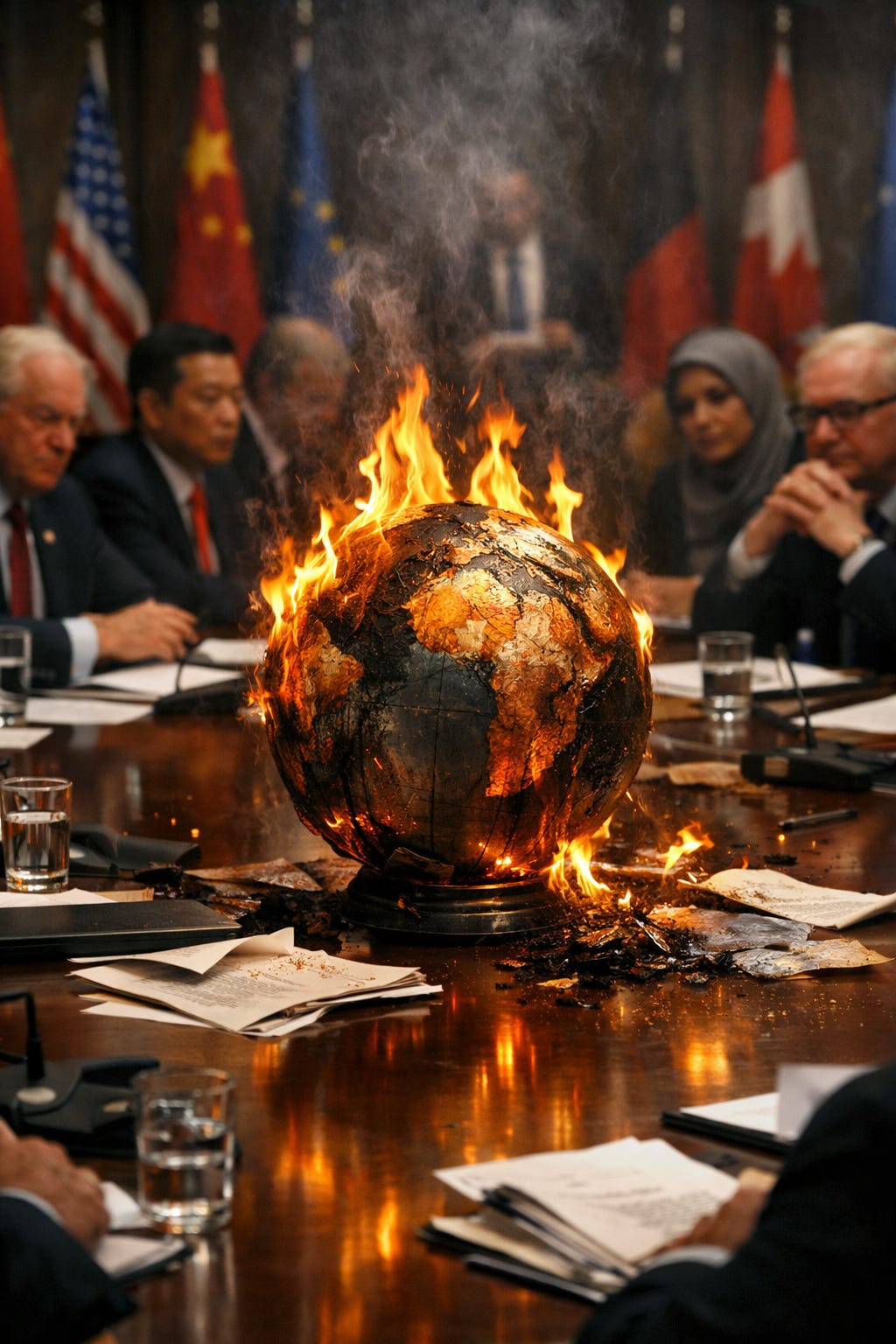
The post-1945 international legal order didn’t erode this morning. It was discarded. Pacta sunt servanda, we were taught. Agreements must be kept.[34] 34The smoke rising over Caracas suggests a different doctrine now prevails.
Barry Appleton is a Distinguished Senior Fellow and Co-Director of the Center for International Law at New York Law School, Managing Partner at Appleton & Associates International Lawyers LP, and a Fellow and Scholar at the Balsillie School of International Affairs.
Press Conference, President Donald J. Trump, Mar-a-Lago (Jan. 3, 2026) (stating “we’re going to run the country until such time as we can do a safe, proper and judicious transition”).
See Tom Cotton (@SenTomCotton), X (Jan. 3, 2026) (” Congress isn’t notified when the FBI is going to arrest a drug trafficker or a cybercriminal here in the United States.”).
Authority of the Fed. Bureau of Investigation to Override Int’l Law in Extraterritorial Law Enf’t Activities, 13 Op. O.L.C. 163 (1989). [hereinafter Barr Memo].
Press Conference, President Donald J. Trump, supra note 1. (” U.S. companies will enter Venezuela, spend billions and start making money for the country.”).
White House, National Security Strategy of the United States of America 19 (Nov. 2025) [hereinafter 2025 NSS] at 19 (announcing a “Trump Corollary to the Monroe Doctrine”).
Agreement Between the United States of America, the United Mexican States, and Canada, July 1, 2020, 134 Stat. 11. ch. 34. (This treaty is known as USMCA in the U.S., CUSMA in Canada).
U.N. Charter art. 2, ¶ 4 (”All Members shall refrain in their international relations from the threat or use of force against the territorial integrity or political independence of any state, or in any other manner inconsistent with the Purposes of the United Nations.”)
Marc Weller, Director, International Law Programme, Chatham House, US Attacks on Venezuela and Maduro Captured: Early Analysis from Chatham House Experts (Jan. 3, 2026).
Mary Ellen O’Connell, Professor, Notre Dame L. Sch., quoted in NBC News (Jan. 3, 2026) (”If you detain someone unlawfully, if you take someone into your custody, and you do not have the legal right to do that, then what else would you call it?”).
Barr Memo, supra note 3, at 185.
Foster v. Neilson, 27 U.S. (2 Pet.) 253 (1829) at 314. (Marshall, C.J.)
Restatement (Fourth) of Foreign Relations Law of the United States § 310 (Am. L. Inst. 2018). reporter’s note 12, (”A treaty’s lack of judicial enforceability is not inconsistent with a status of ‘Law of the Land’ under the Supremacy Clause.”).
Louis Henkin, Foreign Affairs and the United States Constitution 203 (2d ed. 1996).
U.S. Const. art. II, § 3 (”[H]e shall take Care that the Laws be faithfully executed . . . .”).
U.S. Const. art. VI, cl. 2 (”[A]ll Treaties made, or which shall be made, under the Authority of the United States, shall be the supreme Law of the Land.”).
S. Comm. on Foreign Relations, 110th Cong., Treaties and Other International Agreements: The Role of the United States Senate 12 (Comm. Print 2008) (”In accordance with the Constitution, all treaties—whether self-executing or not—are the supreme law of the land, and the President shall take care that they be faithfully executed.”
Letter from Edward R. Stettinius, Jr., U.S. Sec’y of State, to President Harry S. Truman 55 (Ju 26, 1945) (stating that Article 2(4) and related provisions “are binding on the Members”).
Hans Kelsen, The Law of the United Nations 90 (1950) (identifying Article 2(4) as one of two provisions constituting “the main obligations of the Members”).
Brian Finucane, Presidential War Powers, the Take Care Clause, and Article 2(4) of the U.N. Charter, 105 Cornell L. Rev. 1809, 1840–45 (2020)
See Ryan Goodman, Maduro Capture Operation and the President’s Duty to Faithfully Execute U.N. Charter, Just Security (Jan. 3, 2026).
United States v. Noriega, 746 F. Supp. 1506 (S.D. Fla. 1990) (denying motion to dismiss based on alleged international law violations), aff’d, 117 F.3d 1206 (11th Cir. 1997)
United States v. Noriega, 746 F. Supp. 1506, 1539 (S.D. Fla. 1990) (”[S]ince the Court would in effect be condemning a military invasion rather than a law enforcement effort, any ‘remedy’ would necessarily be directed at the consequences and effects of armed conflict rather than at the prosecution of Defendant Noriega for alleged narcotics violations.”).
United States v. Alvarez-Machain, 504 U.S. 655, 669–70 (1992) (holding that forcible abduction does not violate extradition treaty absent express prohibition, and reaffirming Ker v. Illinois, 119 U.S. 436 (1886)).
The Ker-Frisbie doctrine holds that courts possess jurisdiction over criminal defendants regardless of whether their presence was lawfully secured. See Ker v. Illinois, 119 U.S. 436, 444 (1886) (”[S]uch forcible abduction is no sufficient reason why the party should not answer when brought within the jurisdiction of the court which has the right to try him for such an offence.”); Frisbie v. Collins, 342 U.S. 519, 522 (1952) (same).
See Ryan Goodman, supra note 20, (observing that “the Justice Department has not taken the position of the Barr memo in court” and has instead “supported the standard distinction” between judicial enforceability and executive obligation).
2025 NSS, supra note 5, at 19.“After years of neglect, the United States will reassert and enforce the Monroe Doctrine to restore American preeminence in the Western Hemisphere, and to protect our homeland and our access to key geographies throughout the region. We will deny non-Hemispheric competitors the ability to position forces or other threatening capabilities, or to own or control strategically vital assets, in our Hemisphere. This ‘Trump Corollary’ to the Monroe Doctrine is a common-sense and potent restoration of American power and priorities...”
Id. at 5 (”[W]e will no longer tolerate . . . free-riding, trade imbalances, predatory economic practices, and other impositions on our nation’s historic goodwill.”.
Iran-U.S. Claims Tribunal, About, https://iusct.com/about /.
Cuban Liberty and Democratic Solidarity (Libertad) Act of 1996 (Helms-Burton Act), Pub. L. No. 104-114, § 302, 110 Stat. 785, 815 (codified at 22 U.S.C. § 6082).
See Council Regulation 2271/96, 1996 O.J. (L 309) 1 (EC) (EU blocking statute declaring extraterritorial provisions of Helms-Burton Act unenforceable within the EU).
See Tony Stillo, Director, Canada Econ., Oxford Econ., quoted in A Tariff Exemption Was Canada’s Salvation in 2025, Canadian Press (Dec. 31, 2025)
2025 NSS, supra note 5, at 23 (criticizing Canada’s Online Streaming Act and Online News Act as impositions on American digital services firms).
See Clarifying Lawful Overseas Use of Data Act, 18 U.S.C. § 2713 (2018); see also Barry Appleton, Whose Law Governs Canadian Data? The CLOUD Act, Executive Agreements, and Digital Sovereignty. (December 22, 2025). Working Paper Available at https://papers.ssrn.com/abstract=5955017.
Vienna Convention on the Law of Treaties art. 26, May 23, 1969, 1155 U.N.T.S. 331 (”Pacta sunt servanda. Every treaty in force is binding upon the parties to it and must be performed by them in good faith.”).
Appleton's legal analysis is sharp, but it understates Canada's immediate problem. Yes, the Barr Memo theory treats international law as negotiable. What matters more: PM Carney's statement on January 3 called on "all parties" to respect international law while welcoming the transition. That phrasing—"all parties"—treats the U.S. operation as something to be constrained, not normalized. But CUSMA review kicks off July 1. If Washington has just operationalized a theory that treaties constrain only when convenient, Canada's leverage in that negotiation just collapsed. Carney's call for restraint sounds like asking a legal innovator to stop innovating.