
A Made-in-Canada National Security Framework:

Appleton’s Clause & Effect Blog – January 22, 2026 - Part II ⏱ ~7min read
Prof. Barry Appleton
In my earlier piece today (The Limits of Eloquence: Canada’s Davos Moment and the CUSMA Reckoning), I argued that Prime Minister Carney’s Davos performance—however eloquent to the ear—was a strategic miscalculation on the eve of the most consequential trade renegotiation in Canadian history. Diagnosis is not treatment. Eloquence is not strategy. Discretion is the better part of valour.
But critique without construction is insufficient. Canada needs more than criticism of what went wrong. It needs a framework for what must be built.
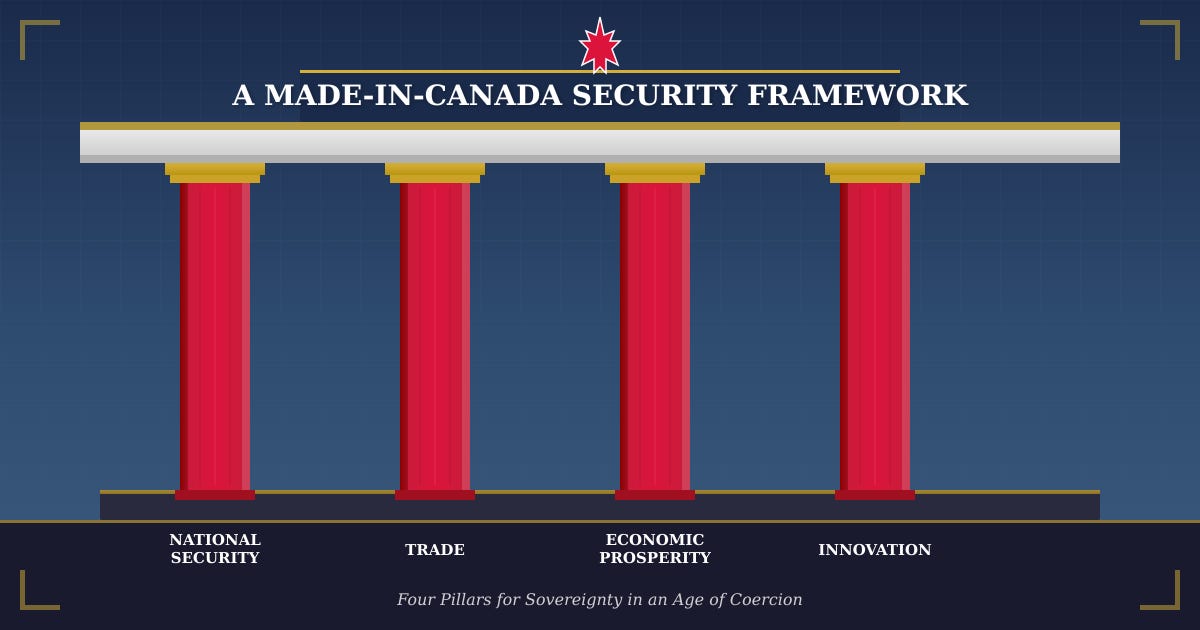
This piece offers that framework: a comprehensive made-in-Canada strategy built around four pillars—national security, trade, economic prosperity, and innovation—integrated into a coherent whole.
Each pillar requires specific institutional reforms and policy actions. Together, they constitute a credible response to the coercive environment Canada now faces.
The Strategic Reality
Canada has entered a fundamentally altered strategic environment. The November 2025 U.S. National Security Strategy makes explicit what practitioners have long understood: economic coercion, extraterritorial law, digital infrastructure control, and algorithmic dominance are now primary instruments of American state power.1
The U.S. National Security Strategy announces that “the days of the United States propping up the entire world order like Atlas are over” and demands allies “assume primary responsibility for their regions.” The document’s assertion of a “Trump Corollary” to the Monroe Doctrine—treating the Western Hemisphere as America’s strategic backyard—directly implicates Canadian sovereignty.2 It is time that Canadians believe the words from President Trump at face value.
Washington now explicitly defines national security to include hemispheric dominance, technological supremacy, supply chain dominance, and control over data, artificial intelligence, and critical resources. It has demonstrated a willingness to use economic pressure, extraterritorial legislation such as the CLOUD Act, tariff threats, and even military posturing to secure these objectives. The reduction of Canada to a potential “51st state” in public rhetoric, combined with aggressive moves toward Greenland, underscores a new reality: allies are increasingly treated as assets rather than autonomous partners.
Canada’s existing legal and institutional framework is not fit for this environment. Authority over national security, trade, digital infrastructure, innovation, and strategic resources is fragmented across statutes designed for a different era.
The Three Tests
Every element of Canada’s national strategy should be measured against three tests:
· First, Sovereignty: Does Canada retain final authority over the matter?
· Second, Prosperity: Does the arrangement build productive autonomy rather than extractive dependency?
· Third, Agency: Does Canada preserve the capacity to say “no”—to refuse proposals and not merely accept them?3
Policies that fail any of these tests require reconsideration. Adaptation is not sovereignty. Diversification is not autonomy. And compliance is not negotiation.
Pillar One: National Security
Canada’s national security architecture was designed for an era of stable alliances and rules-based order. That era has ended. A comprehensive reform requires both institutional modernization and a fundamental reorientation of how Canada defines and defends its security interests.
The Canadian National Security Council
Canada currently governs national security, economic security, trade policy, defense posture, digital sovereignty, and critical infrastructure in silos. In a coercive environment, fragmentation equals exposure. The United States National Security Council integrates these functions at the presidential level. Canada requires equivalent capacity.
Policy Prescription: Establish a Canadian National Security Council (CNSC) as a permanent, statutory body at the centre of government. The CNSC should be located within the Privy Council Office, chaired by the Prime Minister or a designated National Security Chair, and supported by a permanent, security-cleared secretariat.
Membership should include the Ministers of National Defense, Foreign Affairs, Public Safety, Finance, Innovation, Natural Resources, and International Trade; the National Security and Intelligence Advisor; the Chief of the Defense Staff; and the heads of CSIS and CSE.
The CNSC mandate should include: conducting integrated threat assessments across military, economic, and technological domains; coordinating rapid responses to coercive economic or digital actions; evaluating national security implications of trade agreements and major investments; overseeing protection of sovereign data, AI systems, and compute infrastructure; and ensuring defense posture supports rather than undermines economic sovereignty.
This requires legislation. It cannot be improvised through ad hoc committees.
Defense Spending and Credibility
The U.S. National Security Strategy explicitly links defense burden-sharing to commercial treatment. Canada’s current defense spending trajectory is insufficient to meet even the prior 2% NATO target, let alone the new 5% “Hague Commitment.” This matters not merely for alliance credibility but for trade-negotiating leverage. A Canada that fails to meet defense commitments provides Washington with a ready argument for asymmetric commercial treatment.
Policy Prescription: Conduct a comprehensive Defense and Trade Posture Review that establishes a credible path to increased defense spending while ensuring investments prioritize capabilities that reinforce Canadian sovereignty—including Arctic presence, surveillance, and response capacity. Defense integration must be structured to reinforce Canadian sovereignty, not erode it.
Arctic Sovereignty
The Greenland situation illuminates the stakes. American interest in Greenland is driven by critical minerals, strategic positioning, and concern about Chinese and Russian Arctic activity. Canada shares these interests but occupies a different position: as a neighbour to both Greenland and the continental United States, with claims to Arctic waters and resources.
As Prime Minister Carney urged at Davos, middle powers must band together because “if you are not at the table, we’re on the menu.” Canadian Arctic sovereignty requires more than rhetoric. It requires presence: patrol capacity, surveillance infrastructure, and the ability to enforce Canadian law in Canadian waters.
Policy Prescription: Structure NORAD modernization to enhance rather than diminish Canadian Arctic capacity. Accelerate investment in the Port of Churchill—Canada’s only deepwater port with access to the Arctic Ocean and rail—as strategic infrastructure. The federal government has committed $175 million over five years for the Hudson Bay Railway and port expansion; this should be treated as national security infrastructure, not merely regional development.4
As Manitoba Premier Wab Kinew emphasized: “What is our only hope if this Greenland stuff continues? Churchill. Canada has a lot of great plans for the future, but there’s only one port and one rail line that feeds the Arctic.” 5
NATO Solidarity and Alliance Management
Canada’s commitment to NATO Article 5—the principle that an attack on any member is an attack on all—remains unwavering. Yet the prospect of one NATO member threatening another with economic coercion, or even military acquisition, was not contemplated when the treaty was drafted. When European allies deployed military personnel to Greenland in January 2026 as part of Danish-led Arctic exercises, the United States responded with tariff threats.6
Policy Prescription: Maintain NATO solidarity while managing the bilateral relationship with Washington through careful calibration. Canada should continue strong support for allies while avoiding unnecessary provocation. Defense commitments are necessary but not sufficient—they must be accompanied by measures that preserve Canadian decision-making authority over Canadian territorial, economic, and digital domains.
Pillar Two: Trade
Trade policy must serve sovereignty, not substitute for it. Canada has been excessively cautious in exercising the policy space it already possesses under CUSMA and other trade agreements. A more assertive approach to existing rights is not a treaty violation—it is treaty implementation.
The CUSMA Architecture
The Canada-United States-Mexico Agreement was never intended to be a permanent partnership. As Jared Kushner explained in a February 2020 op-ed, drawing on his real estate background: “When you own a great property that you believe will appreciate in value over time, the preference is always to lease space for a shorter duration rather than enter into a long-term, much less a permanent, arrangement.”7
CUSMA’s structure reflects this philosophy. The agreement operates as a “16-year lease” with automatic termination unless renewed, and a fair-market-value readjustment clause triggered every six years. In Kushner’s words: “In the event that the parties disagree on the adjustment, the shortening duration gives the leverage to the stronger party, which, given the relative sizes of our economies, likely will always be the United States.”
The 2026 review is imminent—Secretary Lutnick has confirmed negotiations will begin in the summer. Canada cannot approach this review as a technical exercise. It is a leverage event, structurally designed to favour Washington.
Closing the Institutional Deficit
The asymmetry in negotiating capacity between Canada and the United States is stark. The United States maintains 26 trade advisory committees—including Industry Trade Advisory Committees (ITACs) and Agricultural Technical Advisory Committees (ATACs)—that provide confidential, sector-specific intelligence directly to trade negotiators. These committees operate under security clearances, allowing industry representatives to review draft treaty text and provide real-time tactical advice.
Canada once had an analogous system: the Sectoral Advisory Groups on International Trade (SAGITs). These bodies were dismantled. Canada now enters negotiations with general consultations, where the United States brings precision instruments.
Policy Prescription: Immediately reconstitute the Sectoral Advisory Groups on International Trade—or a modernized equivalent—to provide real-time, confidential, sector-specific intelligence to Canadian trade negotiators. This requires only ministerial action. It does not require legislation. It does not require U.S. approval. It is entirely within the government’s discretionary control. The failure to act on this file is not a resource constraint. It is a choice.8
Using Existing Policy Space
CUSMA contains significant reservations, exceptions, and exclusions that Canada negotiated but has underutilized. Everything not prohibited is permitted. Canada should use every tool its agreements provide—and should be prepared to defend that use in dispute settlement if challenged.
Government Procurement. CUSMA does not contain government procurement commitments between Canada and the United States—the parties instead rely on the WTO Agreement on Government Procurement.9 This architectural choice was deliberate. Canada has significant flexibility to implement procurement preferences for Canadian suppliers in areas not covered by the GPA.
Policy Prescription: Expand and strengthen procurement preferences for Canadian suppliers, particularly for critical infrastructure, defense, and digital systems—including sovereign cloud requirements for government operations.
National Security Exceptions. Article 32.2 of CUSMA permits parties to apply measures they consider “necessary for the fulfilment of obligations with respect to the maintenance or restoration of international peace or security, or the protection of its own essential security interests.”10 Unlike NAFTA’s national security exception, CUSMA’s Article 32.2 does not require that actions be “taken in time of war or other emergency in international relations.” This broader formulation provides greater latitude.
Policy Prescription: Robustly invoke national security exceptions to protect essential security interests in digital infrastructure, AI governance, and critical supply chains. Canada has been reluctant to use these tools. That reluctance should end.
Indigenous General Exception. CUSMA includes, for the first time in a Canadian FTA, a general exception confirming Canada’s ability to adopt or maintain measures necessary to fulfill its legal obligations to Indigenous peoples.11 This exception permits preferential treatment for Indigenous peoples and Indigenous-owned businesses in services, investment, environment, state-owned enterprises, and government procurement.
Policy Prescription: Aggressively expand programs that leverage this policy space, including Indigenous procurement set-asides and preferential access to government contracts for Indigenous-owned enterprises.
Priority Issues for the 2026 Review
The U.S. Trade Representative has already signaled concerns about Canada’s Digital Services Tax, Online News Act, and Online Streaming Act. These are not peripheral irritants—they are targets. The digital economy is essential for Canada’s economic future. In addition, Canada’s moves toward China have now been added to the list of American grievances.
Policy Prescription: Priority issues for the review should include: renegotiation of Chapter 19 digital trade provisions to permit meaningful data sovereignty measures; preservation of cultural industry exceptions; explicit recognition that sovereign compute and AI governance measures fall within national security exceptions; and resolution of the automotive rules of origin dispute, where the United States has failed to comply with the CUSMA panel ruling for over two-and-a-half years.
Pillar Three: Economic Prosperity
A contemporary national strategy must redefine prosperity. For too long, Ottawa has viewed prosperity through the lens of export volume and GDP, ignoring the structural reality of the intangibles economy. True prosperity is productive autonomy—not merely the volume of goods crossing borders, but the retention of value and control within Canadian jurisdiction.
The Intangible Economy Canada Missed
The world shifted from a tangible, production-based economy to one based on intangibles roughly thirty years ago. Canada missed the memo. Today, approximately 90 percent of the market value in the S&P 500 derives from intangible assets—intellectual property, data, algorithms, and brand capital. Yet Canadian policy continues to operate as if we were still in the era of branch-plant manufacturing.
As Jim Balsillie has consistently argued: “You can’t commercialize what you don’t own.”12 Canada spends $7.5 billion annually on research—world-class investments that generate world-class innovations.
But we have no strategy for retaining ownership of outcomes. The result is that Canadian taxpayers fund the R&D, and foreign companies commercialize the results.
This is not innovation policy. This is philanthropy with national resources.
The $100 Billion IP Deficit
In the 20th century, prosperity came from owning the means of production—factories, plants, and physical capital. In the 21st century, prosperity comes from owning the means of value creation: intellectual property, data, and algorithmic systems. Canada has failed to make this shift.
We lose approximately $100 billion annually in intellectual property value—innovations funded by Canadian taxpayers but commercialized abroad. This IP deficit represents the true hemorrhaging of Canadian prosperity.
Innovation without a national IP strategy is philanthropy. You invent it, you invest in it, and others get the benefits.
Policy Prescription: Implement IP Retention Requirements—government-funded research must remain under Canadian ownership, with commercialization frameworks that prioritize domestic scale-up. Reform the Investment Canada Act to treat innovative Canadian companies approaching scale as strategic assets, not acquisition targets.
The FDI Illusion
Canada’s continued reliance on foreign direct investment as an innovation strategy compounds the problem. In the traditional manufacturing economy, FDI created spillovers—a $100 million plant investment might generate $300 million in broader economic benefit. Branch plants were tides that rose all boats.
The innovation economy does not work this way. FDI in the technology sector does not create equivalent spillovers. Instead, it repatriates the top IP, data, and talent from host countries. The dominant effect is not job creation but extraction—reducing Canada to what economist Dan Ciuriak calls the “mediocre middle.” Attracting foreign tech companies is not prosperity—it is extraction dressed in the language of investment.
The Platform Dependency Tax
Currently, Canada pays a “dependency tax” of tens of billions annually to foreign digital platforms—value created by Canadians but extracted by foreign algorithms. Approximately 70% of officially reported Canadian advertising expenditures—$13.5 billion—flow to foreign-owned digital media. [I doubt the completeness of this number. The actual number is likely more than double that.] When combined with payments for cloud services, software subscriptions, and digital infrastructure, the outflow represents a structural deficit that trade statistics fail to capture.
When the Department of National Defense operates on Microsoft 365, or when our financial transactions flow through U.S.-domiciled stablecoin rails, we are externalizing not just value, but strategic leverage.
Policy Prescription: Implement Data Ownership Frameworks that ensure Canadian-generated data creates Canadian value, not foreign extraction. Mandate sovereign cloud requirements for sensitive government operations. Treat digital financial infrastructure—crypto exchanges and payment rails—as critical national security assets under the Investment Canada Act.13
Countering Digital Dollarization
The U.S. National Security Strategy’s focus on “preeminence” extends beyond kinetics and trade into the monetary domain. The Trump Administration’s enactment of the GENIUS Act, which integrates U.S. Treasury debt into the architecture of stablecoins, represents a sophisticated form of monetary imperialism. By incentivizing the global use of USD-backed digital tokens, Washington is effectively exporting privatized monetary dominance.
This poses a direct threat to the Bank of Canada’s monetary sovereignty. With the acquisition of major Canadian platforms by U.S. entities—such as the WonderFi/Robinhood transaction—Canada faces the risk of “digital dollarization”: domestic commerce conducted on U.S.-controlled rails using U.S.-denominated tokens. If we allow our financial plumbing to be owned by foreign entities, our agency to set independent monetary or sanctions policy evaporates.
Policy Prescription: Establish a Financial Sovereignty Firewall. Investment Canada Act reform must recognize digital financial infrastructure as critical national security assets, preventing their transfer to foreign jurisdictions subject to extraterritorial reach like the CLOUD Act. Ensure that settlement layers for Canadian digital commerce remain under Canadian regulatory jurisdiction, immune to foreign sanctions or surveillance mandates.
Pillar Four: Innovation
Innovation policy must be reoriented from attraction to retention—from measuring inputs to securing outcomes. Canada needs not merely to generate ideas but to own them, scale them, and govern the infrastructure on which they run.
Sovereign Compute as Critical Infrastructure
Traditional sovereignty assumed that territory determined jurisdiction. That assumption no longer holds. In the digital economy, data location does not determine legal control, ownership does not determine jurisdiction, and contracts do not defeat foreign statutes.
The CLOUD Act is an excellent example of U.S. extraterritorial control. It creates an environment where U.S. courts can compel access based on possession, custody, or control. Any Canadian data held by a foreign-controlled cloud provider remains exposed to foreign law. The same logic applies to artificial intelligence models, compute infrastructure, algorithmic decision systems, platform governance, and content moderation.
Policy Prescription: Explicitly designate sovereign compute as critical national infrastructure in law, alongside energy grids, telecommunications, and transportation networks. Sovereign compute means: infrastructure not subject to foreign legal compulsion; Canadian operational control over system administration; Canadian custody of encryption keys; and audit and enforcement under Canadian law.
AI systems trained on Canadian data but deployed on foreign-controlled compute are not sovereign. They are dependent. Canada must mandate national security reviews of hyperscale cloud and AI providers, and authorize migration of sensitive government workloads to sovereign systems.
Switzerland provides a model. The Swiss “Apertus” initiative used sovereign supercomputing infrastructure to train a domestic AI model—achieving “full-stack sovereignty”: the data stays in Switzerland, the infrastructure is Swiss-owned, and the model was trained by Swiss institutions on Swiss values. Canada has invested up to $705 million in sovereign compute infrastructure; that investment must be matched by a strategy for training and deploying Canadian models, not merely hosting foreign ones. 14
Confronting the CLOUD Act Problem
Canada must confront the reality that foreign surveillance and data access now occur through legal compulsion, not espionage. Data sovereignty without blocking authority is performative.
Policy Prescription: Amend the Foreign Extraterritorial Measures Act (FEMA) to explicitly cover foreign data access laws, including the CLOUD Act. Require disclosure of foreign legal demands affecting Canadian data. Create statutory authority to block compliance with such demands absent Canadian judicial approval.
AI and Algorithmic Governance
Artificial intelligence is no longer merely a productivity tool. It is governance infrastructure. The decisions made by AI systems—in credit allocation, content moderation, hiring, law enforcement—are increasingly decisions that affect the rights and opportunities of Canadians.
Policy Prescription: Treat advanced AI as dual-use technology. Require security reviews for large-scale AI deployments in critical sectors. Preserve Canada’s authority to audit and constrain algorithmic decision-making. Link innovation funding to sovereign capability outcomes—not merely job creation, but ownership retention and domestic control.
Innovation without control is extraction by another name.
Strategic Resources and Supply Chains
Energy, food, potash, critical minerals, and water are instruments of geopolitical leverage. The U.S. National Security Strategy explicitly prioritizes “securing access to critical supply chains and materials” and states the United States must never be dependent on any outside power for core components.
Policy Prescription: Treat strategic resource supply chains as national security assets. Lower review thresholds for foreign involvement. Impose conditions on data access, pricing algorithms, and control systems. Reorient the Investment Canada Act and Competition Act toward security, not merely efficiency.
The Canadian National Security Act
The policy prescriptions above require a consolidated legislative framework. The proposed Canadian National Security Act would modernize Canada’s fragmented authorities into a single, coherent statute suited to the algorithmic age.
The Act should codify that national security includes digital infrastructure, data, AI, and algorithmic systems. It should shield sovereign compute and AI governance measures from trade retaliation. It should authorize rapid, proportionate countermeasures in response to coercion. And it should establish a statutory framework for invoking existing national security exceptions.
Canada entered the CUSMA digital chapter without completing analysis of its implications for privacy and data localization authority. This must not happen again.
Sovereignty Requires More Than Speeches
The government has an opportunity to lead Canada into this new era with clarity, confidence, and the rule of law. This framework is:
· Pro-sovereignty, not anti-American
· Pro-trade, not naïve about power
· Pro-innovation, anchored in Canadian control
· Firm, lawful, and democratic
A confident Canada is a better ally. A sovereign Canada is a credible partner. But credibility cannot be built on speeches alone. It requires the quiet, disciplined work of building institutional capacity, exercising reserved policy space, and preparing for negotiations with scalpels rather than press releases.
The steel workers in Hamilton, the auto workers in Windsor, the lumber producers in the BC interior, the farmers on the prairies—they will not measure Canada’s success by applause lines from Davos. They will measure it by the terms of the agreement Canada brings home from Washington.
Canada will trade with the world—with the United States, with China, with Europe, and beyond. But it must govern itself on its own terms, through its own institutions, under its own law.
The window to act is narrowing, but it has not closed. It is not too late for our governments (at all levels) to take action to match the eloquence.
This is Part 2of 2 Appleton Clause & Effect Substack’s today - This accompanies - The Limits of Eloquence: Canada’s Davos Moment and the CUSMA Reckoning
The White House, The National Security Strategy of the United States of America (Washington, DC: November 2025), 1.
Ibid., 5, 15. The Strategy states: “The United States must be preeminent in the Western Hemisphere as a condition of our security and prosperity.”
I discuss this approach in my Substack “Sovereignty, Prosperity, Agency: The Real Tests for Canadian Policy” (January 9, 2026)
The Port of Churchill—now owned by the Indigenous-led Arctic Gateway Group, a partnership of dozens of First Nations and Hudson Bay communities—has completed two consecutive seasons shipping critical minerals to Europe. See Caitlyn Gowriluk, “Prime Minister Backs Plans to Redevelop Northern Manitoba’s Port of Churchill,” CBC News, August 26, 2025.
Bryce Hoye, “Manitoba Premier Touts Churchill as Canada’s ‘Only Hope’ Should Trump Move to Acquire Greenland,” CBC News, January 19, 2026.
Robert Gillies, “Canada Weighs Plans to Send Soldiers to Greenland as Show of NATO Solidarity,” Globe and Mail, January 19, 2026.
Jared Kushner, “Op-Ed: This Is the Part of Trump’s USMCA Deal No One Is Talking About,” CNBC, February 3, 2020, https://www.cnbc.com/2020/02/03/op-ed-this-is-the-part-of-trumps-usmca-deal-no-one-is-talking-about.html.
On Canada’s institutional deficit in trade negotiations, see Barry Appleton, “A Sovereign Advisory System for Canada: Rebuilding Strategic Foresight in Trade and Innovation” (CIGI Sovereign Canada Initiative, October 7, 2025), https://ssrn.com/abstract=5575590.
Government of Canada, “Canada-United States-Mexico Agreement (CUSMA)—Government Procurement Summary,” https://www.international.gc.ca/trade-commerce/trade-agreements-accords-commerciaux/agr-acc/cusma-aceum/government_procurement-marches_publics.aspx.
Canada-United States-Mexico Agreement, Article 32.2 (Essential Security). The WTO Panel in Russia—Measures Concerning Traffic in Transit, WT/DS512/R (April 5, 2019), ¶7.130, confirmed that while national security exceptions are not unlimited, states retain substantial discretion when invoking them in good faith.
United States-Mexico Agreement, Article 32.5 (Indigenous Peoples’ Rights General Exception). See Government of Canada, “International Trade Agreements and Indigenous Peoples: The Canadian Approach,” https://international.canada.ca/en/services/business/trade/policy/inclusive/indigenous/approach.
Jim Balsillie, remarks at the Centre for International Governance Innovation, December 2025. Balsillie observed that the recent federal budget “comprehensively ignores the intangible economy” and that IP supports remain “small and token at best.”
I urge readers to read my Substack on the extensive scope of the U.S. CLOUD Act. “Whose Law Governs Canadian Data? The CLOUD Act, Digital Sovereignty.” (January 4, 2026). The blog summarizes my 51-page detailed paper analyzing the act. You can find my full documented legal article.
Barry Appleton, “Whose Law Governs Canadian Data? The CLOUD Act, Executive Agreements, and Digital Sovereignty” SSRN Working Paper (December 2025).
On Canada’s sovereign compute investments, see Innovation, Science and Economic Development Canada, “Canadian Sovereign AI Compute Strategy,” https://ised-isde.canada.ca/site/ised/en/canadian-sovereign-ai-compute-strategy. On the Swiss Apertus model, see M-Q, “First Complete Swiss End-to-End Solution for Sovereign AI,” January 2025.
That $100 billion figure for lost intellectual property is the number that really hurts. We see the receipts for this in the Public Accounts (the government's annual financial report). Ottawa sends billions of tax dollars to researchers. But foreign companies often scoop up the final patents. We pay to invent the technology, and then we pay again to rent it back. That is not an innovation strategy. It is just a donation.
As I reread this over a month later (see my other comment) I think that something is missing here.
Where is protecting our culture and retaining sovereignty, as well as national unity?
Obviously, Quebec is concerned about protection of the French language and French-Canadian culture, but language is a "trade barrier" of a sort with things like news, entertainment & music, internet content etc. - because there is a cost of translation and a minority cultural group will create content unique to its situation, experiences and knowledge that outsiders do not get.
There was a story about the end of translations of "The Simpsons" into Quebec French as opposed to European French - that the show had specific cultural references in the dubbed version, while in English Canada there are no such bits of uniqueness for us since we watch the US version... and we also watch the US version of Jeopardy with its US oriented content while other countries get their own show and content.
News is important - I watch CNN and read the NY Times and Guardian. We have the Post/Sun chain owned by US interests... which arouses suspicion sometimes. But it is hard enough for US newspapers to survive with the decline of print editions, and Canadians suffer and our democracy suffers because the news we get is often US oriented.
We now have to deal with independence movements in two provinces... and with weak national media, people will often only look at the news media that feeds into their prejudices and not necessarily get an honest or full idea of the facts, and certainly foreign governments or business interests can exploit this.
The key jobs of any national government/state is to do what is best for its own people, but to also protect itself from anything that will undermine its survival. Canadians often have a weak sense of our own identity because we mostly speak English and live right beside not only the planets most dominant English speaking country, but the most culturally dominant one. Canadians know far more about US history and institutions than our own - the Freedom Convoy people were confusing US and Canadian (British Parliamentary) systems because they were so ill informed. Ignorance like this is dangerous, because a country not only has to deal with external threats to its survival but that its own people can be turned against it by outside forces or special interests.