
Written Without a Shield
Canada just introduced the right law to protect children online. It forgot to defend itself against the trade war.

Written Without a Shield
Canada just introduced the right law to protect children online. It forgot to defend itself against the trade war.
By Prof. Barry Appleton | Appleton’s CLAUSE & EFFECT Substack| 10 June 2026 · · Digital Sovereignty
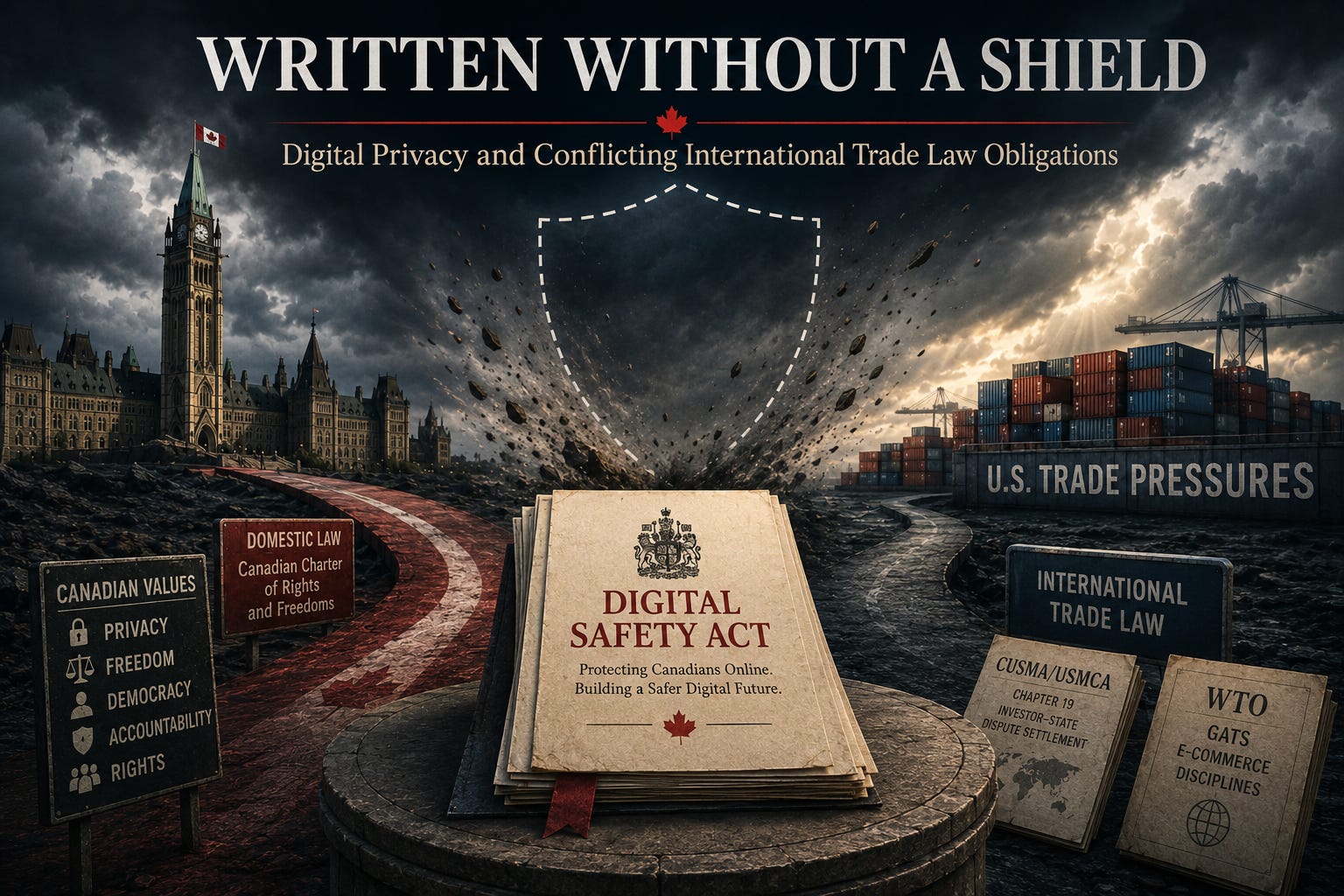
Today, the government introduced Bill C-34, Canada’s draft legislation on digital safety. It is a serious bill, built to protect children, and the instinct behind it is right. The problem is not the bill. The problem is that Canada is entering a trade war without a shield, three weeks before the CUSMA review window opens.
Today’s introduction of this long-awaited legislation has resulted in an extra edition of Appleton’s Clause & Effect Substack. This piece extends the Digital Sovereignty series. Part One, “The Rules Washington Is Writing,” described how the United States writes the rules of the digital economy through trade instruments. Part Two, “The Code Canada Has Not Written,” argued that Canada keeps announcing the right ambitions in the wrong order. Bill C-34 is the test case: a real bill, in real text, that proves the point. The trade-law analysis draws on Locked In and Locked Out, The Exits Exist, and Know Your Ground.
Bill C-34, introduced today, would do things Canada plainly should be able to do. It would make platforms verify a user’s age before showing them pornography. It would require synthetic content, the deepfakes, to be labeled. It would force the fastest possible removal of the worst material online: child sexual abuse images and intimate images shared without consent. And it would impose real duties on the chatbots that millions of people now talk to every day, including a duty to end the conversation and route a user to a human if that user signals they are about to harm themselves.1
Start where it matters most. The instinct behind this bill is right. A country should be able to protect children from sexual abuse material, from deepfakes built out of their faces, from algorithms tuned to keep them scrolling, and from AI systems that talk a vulnerable teenager toward self-harm. This is not regulatory overreach. It is Parliament’s core job. Any version of the trade argument that ends with “so Canada should not act” has lost the plot. That is not the argument.
The argument is about timing and exposure. C-34 is walking into the most aggressive American trade-enforcement posture in a generation, at the worst possible moment in the calendar, and it is walking in undefended. The question is not whether Canada should protect the public. It is how Canada does that and survives the trade war at the same time.
The instinct is right. Protecting the public is Parliament’s job. The failure is not the ambition. It is sending the ambition into a trade war without a shield.
The trap, in one picture
Here is the problem in a single image. C-34 creates a new federal Commission that can order a platform to make content inaccessible to Canadians within twenty-four hours2. Picture that order landing on Meta or X: take this down across the country by tomorrow.
Now look at what the United States did three weeks ago. On June 1, the U.S. Trade Representative formally determined that Brazil’s court orders telling American social media companies to take content down were “unreasonable,” an actionable offense under U.S. trade law, and proposed a twenty-five percent tariff on Brazilian goods in response.3 A Canadian Commission ordering Meta or X to pull content in twenty-four hours is the same fact pattern Washington just punished in another country. We would hand the United States the exact template it already uses. That precedent is three weeks old.
A Canadian Commission ordering U.S. platforms to take content down in twenty-four hours is the same thing Washington just hit Brazil with a twenty-five percent tariff for. The precedent is three weeks old.
The part nobody is talking about: the chatbots
The sharpest exposure in C-34 is one almost no one has noticed yet, and it lives in the chatbot rules.
C-34 tells companies that run conversational AI systems that they cannot use “manipulative engagement techniques” to keep a user hooked, and cannot let the system pretend to be a human being, a licensed doctor, or a licensed lawyer. Those are sensible rules. But think about what it takes to comply with them. To stop a chatbot from manipulating a user or posing as a person, a company has to delve into the model and change how it is built and how it behaves.
And that is the catch. CUSMA contains a provision specifically designed to prevent Canada from forcing a company to open up or alter the inner workings of its software, source code, and algorithms.4 So, the chatbot duties slip out from under the platform rules everyone has been arguing about and land instead on the one part of the treaty designed to keep the machine’s internals beyond Canadian reach. Canada would be regulating exactly the algorithmic behavior that the agreement was built to protect. It is a genuinely new collision, and C-34 is the first Canadian bill to trigger it.
It’s as if the team drafting the legislation was obsessed with evading the platform immunity rules and overlooked the equally binding prohibitions on code and algorithms.
This does not land on a clean desk
C-34 is not arriving in a calm relationship. Canada’s Online Streaming Act and Online News Act are already named as irritants in the U.S. government’s official list of foreign trade barriers.5 C-34 would be the third Canadian digital measure on that American file, at the worst possible moment in the calendar.
And the American posture could not be clearer. The U.S. Trade Representative has publicly named “discrimination against U.S. technology companies” as a target for trade investigations now covering some sixty countries.6 The President has put every country with “Digital Services Legislation” on notice by name, calling such laws “designed to harm” American technology and threatening both tariffs and a cutoff of advanced chips.7 And the Commerce Department is building a case file on “burdensome” AI rules.8 C-34 checks every one of those boxes at once: it is digital services legislation, it regulates AI, and it can order American platforms around. The Section 122 trade clock runs out on July 24. The calendar is not on Canada’s side.9
C-34 would be the third Canadian digital measure on the American file: digital services legislation, AI regulation, and platform takedown orders, all in one bill, at the worst moment in the calendar.
The good news: the exits are real
Here is the part that should make people determined rather than defeated. CUSMA has exits built into it. Canada simply has not used them. But that does not have to be a permanent condition. Three matter most.
Use the reservations Canada already has, but do not expect much. When Canada signed CUSMA, it carved out protected space for itself in the services and investment chapters, and a digital measure like C-34 can, in principle, draw on those carve-outs.10. I have matched them against C-34, and the result is sobering. The carve-outs were written to guard against the services-and-investment rules: discrimination, local-presence, and market-access requirements. The one that looks closest, a reservation covering public law enforcement and social services like childcare and health, does not actually fit, because it protects Canada when Canada itself supplies those services, not when Canada regulates private platforms. And the rules most likely to be thrown at C-34, that it treats foreign platforms arbitrarily, unfairly, or in a discriminatory way, cannot be reserved against at all. Those protections are guaranteed by the agreement; no carve-out reaches them. The reservations protect the edges of this bill. They do not protect their core, and on the most dangerous ground, they protect nothing. That is what makes the next two exits the ones that matter.
Claim the national-security exception, out loud, up front. CUSMA lets a country take measures it considers necessary for its own essential security, and that exception is judged on a forgiving, good-faith standard rather than a hard necessity test.11 Stopping child sexual abuse material and content that incites attacks on critical infrastructure plausibly fits. But Canada has to assert that framing when it introduces the law, not invent it later in a defense. Canada asserted nothing of the kind on the Digital Services Tax, and we all watched how that ended12
Ask for the same shield the Americans built for themselves. This is the one I would put in front of any Canadian audience. CUSMA already contains a special carve-out that protects the United States’ own anti-trafficking platform law from challenge by labeling it a “public morals” measure and lifting it out of dispute entirely 13. The Americans wrote that shield for their own child-protection law. Canada should walk into the CUSMA review and ask for the identical carve-out for the heart of C-34, the child sexual abuse and intimate-image provisions, because the United States has already conceded that this category deserves protection. The strongest version of the ask is the narrowest one. Narrow is not a weakness here. Narrow is what makes the shield hold.
The bill is strongest exactly where it is narrowest. The child-protection core is defensible. The broad content rules and the chatbot rules are where the danger is.
How to do this and deal with the trade war
Parliament should protect the public. The answer to the trade exposure is not to drop the bill. It is to arm it. Four steps, in sequence, while C-34 is still moving through the House.
First, sequence the defense before the obligation. Assert the national-security framing for the child-protection and critical-infrastructure provisions now, as the bill is debated, rather than holding it back for a dispute that will arrive on Washington’s timetable. Build the domestic legal architecture before the treaty exposure is tested.13
Second, do not rely on the reservations to do work they cannot. The mapping is done. Canada’s CUSMA carve-outs apply only to the discrimination, local presence, and market access rules. The one that looks closest, the social-services reservation, does not fit, because it covers Canada’s own supply of social and law-enforcement services, not the regulation of private operators. And the disciplines most likely to be invoked against C-34, that it is arbitrary, unfair, or discriminatory, are non-reservable as a matter of treaty design. The cross-chapter route is a false comfort. That is precisely why the security assertion and the public morals carve-out have to carry the weight.
Third, take the carve-out to the table. Make a parallel “public morals” carve-out for C-34’s child-protection core an explicit Canadian objective in the CUSMA review, modeled directly on the one the Americans wrote for their own law.
Fourth, make the affirmative case now, about this bill. A strong, independent Canadian digital-safety regime is an American strategic asset, not a trade barrier. A Canada that can credibly police child sexual abuse material, deepfakes, and AI-driven harm is a more trustworthy partner, not a less convenient one. That argument was made directly to U.S. trade officials in December. It needs to be made specifically about C-34 in the review, before the bill is used against Canada rather than for it.
The deeper point is the one this series keeps returning to. The bill is not the error. The domestic policy nakedness is the error. Canada has written real law to protect children, in real statutory text, and is about to send it across the line without the trade-law shield that would let it survive contact. A child-safety law introduced with its security framing asserted, the limits of its reservations understood, and its review objective on the table is a sovereign act. The same law sent out bare is a target list.
The bill is not the error. The nakedness is the error. A child-safety law sent into a trade war without a shield is not sovereignty. It is an invitation.
Protecting children online is the right ambition. Doing it in a way that holds against the trade war is the harder task, and the more important one. The two are not enemies. They only become enemies when Canada writes the code and forgets the shield.
Prof. Barry Appleton is Managing Partner of Appleton & Associates International Lawyers LP, Co-Director of the Center for International Law at New York Law School, and Interim Director of the Balsillie Legal Advisory Centre at the Balsillie School of International Affairs. This piece extends his Digital Sovereignty series and the analysis in Locked In and Locked Out and The Exits Exist..
© 2026 Barry Appleton. All rights reserved.
Bill C-34, An Act to enact the Digital Safety Act and the Digital Safety Commission of Canada Act and to make consequential amendments to other Acts (short title, Safe Social Media Act), 1st Sess., 45th Parl., introduced June 10, 2026. References in this piece are to the bill as introduced at first reading.
The duty-to-make-inaccessible and Commission order provisions of C-34 engage CUSMA Article 19.17(2), which prohibits a Party from treating an interactive computer service supplier as the author of content another person created. The U.S. analogue is Section 230 of the Communications Decency Act, 47 U.S.C. § 230(c)(1). For the full treatment, see Barry Appleton, Locked In and Locked Out: How CUSMA’s Digital Trade Architecture Constrains Canadian Sovereignty—And Where the Exits Still Exist, SSRN Working Paper No. 6390198 (2026), at 41–44.
Office of the U.S. Trade Representative, Section 301 Determination on Brazil’s Unreasonable Acts, Policies, and Practices (June 1, 2026), Docket No. USTR-2026-0331 (finding that Brazilian court orders directing U.S. social media companies, including X, Meta, and Google, to take down content and suspend profiles are unreasonable and actionable under Section 301, and proposing a 25% tariff; public hearing set for July 6, 2026; statutory deadline July 15, 2026).
CUSMA Article 19.16(1) prohibits a Party from requiring the transfer of, or access to, source code or algorithms as a condition of market access. The narrow exception in Article 19.16(2) applies only to a “specific investigation, inspection, examination, enforcement action, or judicial proceeding,” not to general, all-provider design mandates of the kind C-34’s chatbot duties create. See Locked In and Locked Out at 23, 39–40.
Office of the U.S. Trade Representative, 2026 National Trade Estimate Report on Foreign Trade Barriers (Mar. 31, 2026), Canada chapter, at 67 (identifying the Online Streaming Act, the Online News Act, and Quebec’s Bill 109 as measures under monitoring for CUSMA implications).
U.S. Trade Representative Jamieson Greer, Statement on the Supreme Court IEEPA Decision (Feb. 20, 2026) (naming “discrimination against U.S. technology companies and digital goods and services” and “digital services taxes” among accelerated Section 301 investigation categories covering most major trading partners).
Donald J. Trump, statement on Truth Social (“Digital Taxes, Digital Services Legislation, and Digital Markets Regulations are all designed to harm, or discriminate against, American Technology,” threatening “substantial additional Tariffs” and export restrictions on “Highly Protected Technology and Chips” against countries maintaining such measures).
Executive Order on state artificial-intelligence regulation (Dec. 2025) (directing the Secretary of Commerce to identify “onerous” and “burdensome” AI laws for referral to a Department of Justice litigation task force, with particular criticism of algorithmic-conduct mandates). C-34’s chatbot design duties are the same species of AI-conduct regulation the administration treats as a burden.
On the Section 122 statutory clock (expiring July 24, 2026) and the CUSMA review calendar, see Barry Appleton, Settled Out of Congress (Clause and Effect, June 8, 2026).
CUSMA Article 19.2(4) imports into Chapter 19 the non-conforming measures applicable to the obligations in Chapter 14 (Investment) and Chapter 15 (Cross-Border Trade in Services); a service supplied in Canada through commercial presence is treated as a covered investment governed by Chapter 14 (arts. 14.3.4, 15.2). The author has mapped Canada’s Annex II schedule against C-34. The only arguably relevant reservation, Social Services (II-C-6), does not fit: it reserves Canada’s own supply of public law enforcement, correctional, and public-purpose social services, not the regulation of private operators. More fundamentally, Canada’s reservations reach only the national treatment, most-favoured-nation, performance-requirement, senior-management, local-presence, and market-access obligations (art. 14.12). They do not, and cannot, reach the minimum standard of treatment (art. 14.6), which protects against arbitrary, unfair, and discriminatory treatment and is non-reservable; nor do they reach the platform-immunity (art. 19.17) or source-code (art. 19.16) disciplines that are C-34’s core exposure. See CUSMA arts. 14.6, 14.12, and Annex II (Schedule of Canada); Barry Appleton, Locked In and Locked Out at 24–28.
CUSMA Article 32.2 (essential security): “measures that it considers necessary” for the protection of a Party’s own essential security interests. The self-judging language is assessed on a good-faith/plausibility standard, a materially lower bar than the general-exceptions necessity test in Article 32.1. See The Exits Exist: Canada’s Strategic Case for the 2026 CUSMA Review, SSRN Working Paper No. 6491461 (2026).
On the Digital Services Tax sequencing failure—Canada legislated and then abandoned the measure under pressure without the institutional and legal architecture to sustain it—see Barry Appleton, Know Your Ground: Canada’s Strategic Imperatives for the 2026 CUSMA-USMCA Review, SSRN Working Paper No. 6643319 (rev. Apr. 30, 2026).
Barry Appleton, Code Before Clause: Building Canada’s Digital Defences Before Negotiating Trade (Balsillie Papers, 2025) (the proper sequence is for legislatures first to establish domestic frameworks for AI, data protection, and platform accountability, and only then to translate those frameworks into trade commitments); and Law, Not Leverage: A Rules-Based Path for the USMCA Review, Rebuttal Submission, Docket No. USTR-2025-0004 (Dec. 12, 2025) (arguing that robust, independent Canadian digital sovereignty is a U.S. strategic asset, not a trade barrier).