
Settled Out of Congress
The Legal Authority behind the New U.S. Trade Architecture

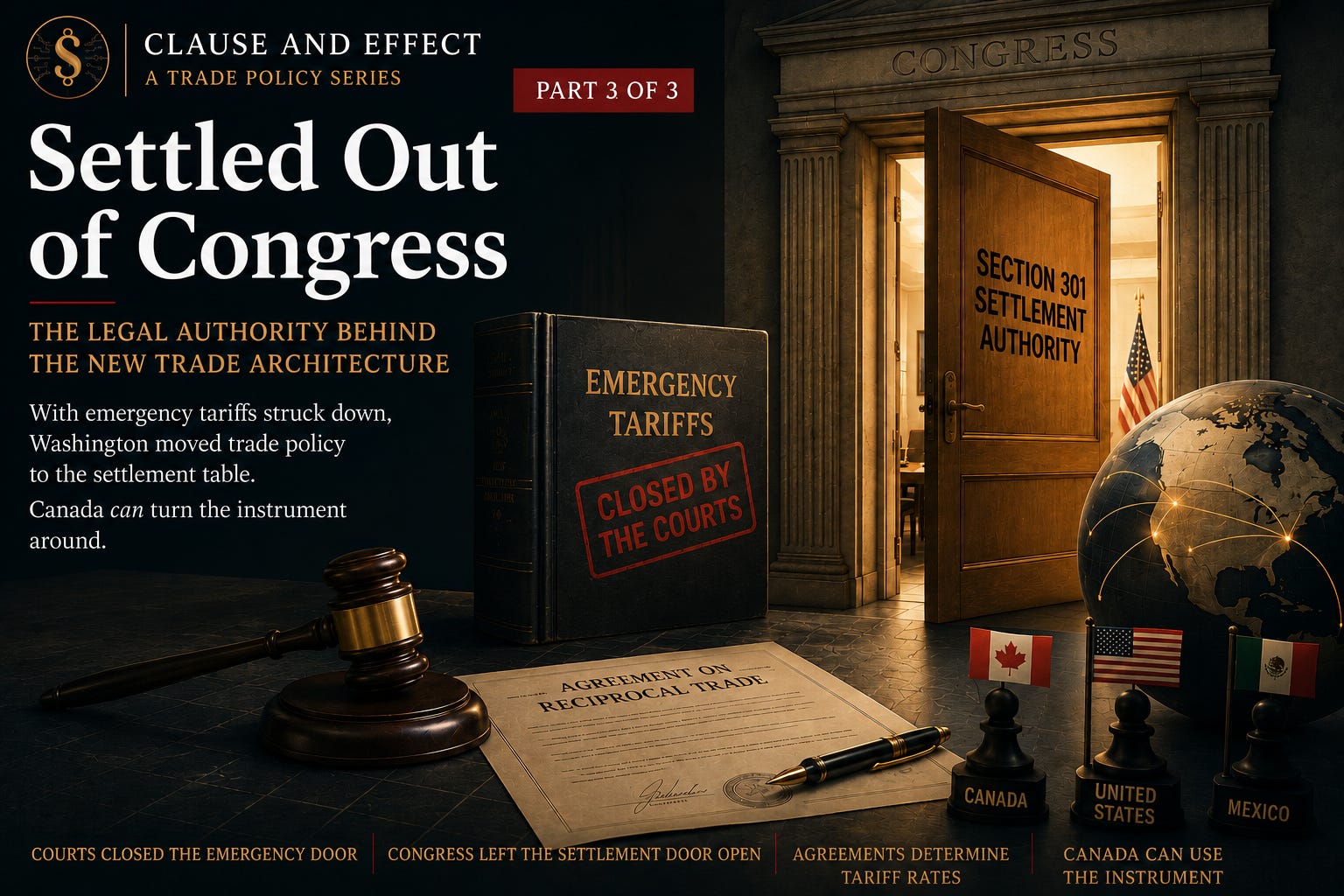
Settled Out of Congress: The Legal Authority behind the New U.S. Trade Architecture
By Prof. Barry Appleton | Appleton’s CLAUSE & EFFECT Substack| 8 June 2026 · Part 3 of 3
Editor’s Note: This is the third and final piece in a three-part series on the new architecture of American trade policy. Part One, “Reciprocal in Name Only”, explains what the Agreements on Reciprocal Trade are and why the word on the cover is misleading. Part Two, “Already in Motion,” maps the U.S. Section 301 investigations targeting Canadian interests that were already running before the USMCA-CUSMA Joint Review ostensibly opens on July 1, 2026. This third piece examines the authority, or the absence of it: where the legal power behind the new trade architecture comes from, now that the Supreme Court has acted. The economic stakes across all three questions are analyzed in three longer papers: “No Going Back”, “Know Your Ground”, and “The Exits Exist”.
Washington lost its tariffs in court, so it moved trade policy to the settlement table. But trade allies like Canada can still turn the instrument around.
This month, the Office of the United States Trade Representative announced determinations in sixty Section 301 investigations over forced labour, covering most of America’s trading partners, and proposed a two-tier tariff remedy. Most of the world would face an additional 12.5 percent duty. A smaller group would pay 10 percent: economies that prohibit the importation of goods made with forced labour, that operate a partial regime, or that have committed to such a prohibition through an Agreement on Reciprocal Trade.1
Read that third route again. A country can earn a lower tariff rate by signing the Washington bilateral template.
Signing Washington’s bilateral template is now a tariff-rate-determining event.
That sentence is the key to understanding what American trade policy has become in 2026, and what is waiting for Canada when the USMCA-CUSMA Joint Review opens on July 1.
The courts closed the emergency door
Start with what the courts have done, because the new architecture only makes sense in light of it.
On February 20, the Supreme Court held in Learning Resources, Inc. v. Trump that the International Emergency Economic Powers Act does not authorize the President to impose tariffs. The vote was 6 to 3. The Liberation Day reciprocal tariffs and the trafficking tariffs fell with it.2 On May 7, the Court of International Trade struck the successor regime, the 10 percent global tariff imposed under the balance-of-payments authority in Section 122 of the Trade Act of 1974, although a Federal Circuit stay keeps collection running while the appeal proceeds.3 And Section 122 carries its own fuse regardless: the statute caps the President at 15 percent for 150 days, a clock that runs out on July 24, 2026.4
Two emergency authorities, two judicial defeats, one statutory expiry. A reasonable observer might conclude that the executive tariff project was finished. That observer would be reading the wrong statute.
The courts closed the emergency door. The settlement door was standing open the whole time.
The door Congress left open
Section 301 of the Trade Act of 1974 authorizes the Trade Representative, after an investigation finds that a foreign act, policy, or practice burdens or restricts U.S. commerce, to do three things: impose duties, suspend trade agreement concessions, or enter into a binding agreement with the foreign government to eliminate the conduct or compensate the United States.5
The first option is litigation-tested; the Federal Circuit upheld the China tariffs under it. The third option is the interesting one. It is a settlement provision. Congress wrote it so that a trade dispute could end the way litigation does, with a negotiated instrument rather than an imposed remedy. And like any settlement regime, it comes with a leash: Section 301 actions sunset after four years (under Section 307) unless reviewed and continued, which makes every settlement a recurring appointment on Washington’s calendar.6
Here is how the machine was assembled. In March 2026, three weeks after the Supreme Court ruling, USTR launched two waves of Section 301 investigations: sixteen economies on structural excess capacity, and sixty economies, Canada among them, on the failure to impose and effectively enforce forced labour import prohibitions.7 The investigations were openly described as the durable replacement for the invalidated emergency tariffs. Meanwhile, the bilateral deals concluded under tariff pressure in 2025, the Agreements on Reciprocal Trade, nine signed so far, were left stranded by the Court’s ruling: their consideration was relief from tariffs that no longer lawfully existed.8
The June determination repairs that defect. By making an ART commitment a qualifying route to the 10 percent tier, USTR gave the same bilateral commitments fresh consideration under a statute the courts have blessed. The Peterson Institute reached the same conclusion this week: the wording of the new investigations indicates that Section 301 outcomes will serve as the legal basis for the tariff rates negotiated through the ARTs and for the penalty rates threatened if a partner falls out of compliance. All nine ART signatories sit inside the sixty-economy investigation. Five of the nine sit inside the sixteen.9 Investigating your own settlement partners is not a contradiction. It is the enforcement mechanism.
U.S. Trade Representative Greer described the method himself in April testimony to the House Ways and Means Committee: Section 301 actions against digital services taxes have been drafted but not deployed, while the reciprocal trade agreements concluded with other countries already contain commitments prohibiting those taxes. Tariffs, he said, should not exist just for tariffs’ sake; the point is outcomes.10 Investigation drafted. Settlement extracted. Action held in reserve. That is litigation practice, transplanted into treaty-making.
What the settlement table bypasses
The Constitution assigns the regulation of foreign commerce to Congress. Trade Promotion Authority, the mechanism by which Congress pre-authorizes trade agreements and guarantees them an implementing vote, expired on July 1, 2021, and has never been renewed.11 Any conventional renegotiation of an agreement like USMCA-CUSMA would require implementing legislation through regular congressional order.
The settlement route requires none of that. The Congressional Research Service (CRS) has stated the constitutional baseline plainly: because Congress holds the foreign commerce and tariff powers, it is doubtful that the President may conclude trade agreements as sole executive agreements, and there is scant case law on the question.12 Senators have objected on exactly these grounds, and Georgetown’s Kathleen Claussen, the leading scholar of these instruments, puts it directly: “The Constitution is clear: Article I assigns foreign commerce power to Congress. The executive branch does not have independent authority to enter into trade agreements that create binding commitments for the United States.”13 CRS, politely, has separately observed that the agreements concluded by this administration without congressional approval are arguably less legally and politically durable than agreements Congress approved, like USMCA, and may invite legal challenge or retrospective conditions. 14
The administration’s best answer is that the settlement clause itself is the congressional authorization: Congress, in Section 301, expressly contemplated binding agreements as a remedy. The Phase One Agreement with China, concluded in connection with a Section 301 investigation and never submitted to Congress, is the precedent.15 It is not a frivolous answer. But it has a scope problem. Congress authorized agreements that eliminate the conduct under investigation or compensate the United States. The ARTs reach export control alignment, investment screening, third-country restrictions, and clauses permitting termination if a partner concludes agreements that Washington dislikes. The further the instrument drifts from the investigated conduct, the weaker the statutory anchor becomes and the more it resembles the sole executive agreement that the CRS regards as constitutionally doubtful.
And yet the doctrine may never be tested, because the design is plaintiff-proof. Foreign governments cannot enforce or challenge these instruments in U.S. courts.
Importers can challenge tariffs, not agreements. Congress writes letters. The genuine pressure points are narrower: a pending Supreme Court petition challenging USTR’s power to expand existing Section 301 actions through “modification,”16 and a procedural requirement that belongs to Canada and Mexico under the USMCA-CUSMA.
Where Canada stands in this machinery
The specific Section 301 investigations that make up the pipeline Canada is walking into on July 1 are mapped in Part Two of this series, “Already in Motion” (Clause and Effect, June 7, 2026): the forced labour proposed action with its July 6 comment deadline, the digital and streaming investigation armed and pointed by the CRTC’s May 21 decision, and the pharmaceutical and IP tracks approaching the initiation stage. This piece examines the legal question beneath that pipeline: where does the authority for these investigations, and for the settlement instruments they are designed to produce, now come from, given that the courts have acted?
Canada’s position in the new architecture is precise and worth stating precisely.
Canada is named in the sixty-economy forced labour investigation. Canada is not named in the sixteen-economy excess capacity investigation, which sweeps in Mexico, the European Union, Japan, Korea, and India. And within the forced labour action, Canada qualifies for the lower 10 percent tier not through any bilateral deal but through its existing forced labour import prohibition, the one Canada adopted to implement Article 23.6 of USMCA-CUSMA itself.17
Sit with that for a moment. Canada’s ratified treaty commitment, implemented in Canadian law and approved by three legislatures, is priced in the June determination at exactly the same tariff tier as an unratified executive handshake from Bangladesh or Guatemala. The instrument Congress approved and the instrument Congress never saw are treated as interchangeable.
| Canada’s ratified treaty commitment is priced identically to an unratified executive deal. That is the tell.
That equivalence is the whole strategy in miniature. It tells you the agreements are being converted from contracts into options. And it tells you what the ART is for in the North American context: it is the USMCA-CUSMA bypass.
The USMCA-CUSMA Joint Review can formally succeed; the parties can confirm an extension under Article 34.7; and the operative regulatory commitments on digital taxes, export controls, and third countries can migrate sideways into a bilateral instrument that no parliament reviews and that renews on a four-year leash.
Mexico is already in the pre-review bilateral channel, named in both investigations, with USTR announcing agreed next steps. The complaint against Canada has been kept warm for the same reason: USTR’s theory is that Canada’s prohibition exists but is rarely enforced, with few, if any, shipments being detained.18 An enforcement complaint is infinitely renewable. The 10 percent tier is grace, not safe harbour.
The positive option: settle inside the treaty, not beside it
Here is the good news, and there is real good news. The settlement mechanism has a property Washington’s lawyers know well: a settlement is only as good as the forum, and on this file, Canada gets to argue about the forum. Canada can do three things, starting now.
Settle inside the treaty, not beside it.
First, Canada needs to show up in the proceedings and put the trade agreement on the Section 301 record. Requests to appear at the Section 301 hearing are due June 22; written comments are due July 6. Section 301 contains its own forum-selection clause: where an investigation involves matters covered by a trade agreement, the statute directs USTR to the dispute settlement procedures of that agreement.19 Canada’s forced labour obligation is a USMCA-CUSMA obligation. The lawful forum for a complaint about Canada’s performance of Article 23.6 is USMCA-CUSMA Chapter 31, not a unilateral tariff. Canada should make that argument formally, in the proceedings and in writing, before July 6. Other states will appear - why not Canada? The argument may not stop the tariff. It builds the record for the panel that follows and forces Washington to choose publicly between its statute and its workaround.
Second, make enforcement Canada’s offer, payable inside the treaty. Washington’s stated grievance is real enough to work with: prohibitions on paper, detentions near zero, on both sides of the border. Canada should arrive at the Joint Review with a North American forced labour enforcement protocol as an affirmative proposal under USMCA- CUSMA Article 23.6: detention and disclosure benchmarks, supply chain data sharing, dedicated CBSA enforcement capacity, and a trilateral review mechanism. This gives Washington the outcome Ambassador Greer says he wants, and it pays the settlement currency into ratified Canadian law, where the commitment binds all three parties symmetrically and survives the next election in any of the three capitals. The same conduct that buys a four-year reprieve inside an ART, also buys a permanent, reciprocal, enforceable right inside USMCA-CUSMA. Same price. Better instrument. Canada should say so out loud: we do not pay treaty consideration for executive options.
Third, build the capacity to read what is on the table. Nine ART texts now exist in public. The fifteen U.S. Industry Trade Advisory Committees are dissecting them clause by clause with security-cleared industry advisers. Canada dismantled its own Sectoral Advisory Groups on International Trade (SAGITs) in 2013 and has never rebuilt them.20 Before July 1, Ottawa should stand up a standing instrument-review capacity, a reconstituted SAGIT system with a mandate that explicitly includes executive instruments, side letters, and settlement templates, not just treaty text. The rules governing Canadian firms are increasingly set out in documents that never undergo a ratification process. Someone in Canada has to be reading them with the same care as the people drafting them. Build the code before you negotiate the clause.
The spread Canada must restore
Trade agreements are being converted from contracts into options.
An Agreement on Reciprocal Trade is an option Washington holds: exercisable, repriceable, renewable on a four-year cycle, enforceable by a tariff that sits in a drawer, drafted. USMCA-CUSMA is a contract that three legislatures wrote into law. The June determination priced these two instruments identically, and that pricing error is the single most important fact Canadian negotiators should carry into July.
Canada’s task in the USMCA-CUSMA Joint Review is to restore the spread: to demonstrate, in the proceeding, at the table, and in its own institutions, that ratified law is worth more than an executive option, and to refuse to pay contract prices for option paper. The settlement table is open. Canada should sit down at it and then move the table inside the treaty.
This is Part 3 of a three-part series. Part 1, “Reciprocal in Name Only,” was published Saturday (June 6, 2026). Part 2, “Already in Motion,” was published Sunday (June 7, 2026).
Prof. Barry Appleton is Managing Partner of Appleton & Associates International Lawyers LP, Co-Director of the Center for International Law at New York Law School, and Interim Director of the Balsillie Legal Advisory Centre at the Balsillie School of International Affairs.
© 2026 Barry Appleton. All rights reserved.
Endnotes
Office of the U.S. Trade Representative, USTR Makes Findings and Proposes Action in 60 Section 301 Investigations Relating to Failures to Take Action on Trade in Forced Labor Goods (June 2026), (proposing additional duties of 10% for economies with a forced labour import prohibition, an Agreement on Reciprocal Trade commitment, or a partial regime, and 12.5% for all others; hearing requests due June 22, 2026; written comments due July 6, 2026) Oral testimony on July 7, 2026.
Learning Resources, Inc. v. Trump, 607 U.S. ___ (2026) (decided Feb. 20, 2026) (holding that IEEPA does not authorize the President to impose tariffs).
Oregon v. Trump, Slip Op. 26-47 (Ct. Int’l Trade May 7, 2026) (striking the Section 122 tariffs), stayed pending appeal (Fed. Cir. May 12, 2026) (tariff collection continuing under the administrative stay).
Trade Act of 1974 § 122, 19 U.S.C. § 2132 (authorizing import surcharges of up to 15% ad valorem for a maximum of 150 days absent congressional extension; the current authority expires July 24, 2026).
Trade Act of 1974 § 301(c)(1), 19 U.S.C. § 2411(c)(1) (authorizing the Trade Representative to impose duties or other import restrictions, withdraw or suspend trade agreement concessions, or enter into a binding agreement with the foreign government to eliminate the conduct, eliminate the burden on U.S. commerce, or provide compensatory trade benefits).
Trade Act of 1974 § 307(c), 19 U.S.C. § 2417(c) (Section 301 actions terminate after four years absent a continuation request and review).
Initiation of Section 301 Investigations: Acts, Policies, and Practices of Certain Economies Relating to Structural Excess Capacity and Production in Manufacturing Sectors, 91 Fed. Reg. 12,886 (Mar. 17, 2026) (sixteen economies, including Mexico, the European Union, Japan, Korea, and India, excluding Canada); Initiation of Section 301 Investigations of Acts, Policies, and Practices of Various Economies Related to the Failure to Impose and Effectively Enforce a Prohibition on the Importation of Goods Produced with Forced Labor, 91 Fed. Reg. 12,884 (Mar. 17, 2026) (sixty economies, including Canada); Office of the U.S. Trade Representative, The United States and Mexico Announce Next Steps in Bilateral Discussions in Advance of the USMCA Joint Review (2026).
Exec. Order No. 14346, Modifying the Scope of Reciprocal Tariffs and Establishing Procedures for Implementing Trade and Security Agreements, 90 Fed. Reg. 43,737 (Sept. 10, 2025); Congressional Research Service, Section 301 Investigation: Forced Labor and Import Policies of U.S. Trading Partners, IN12672 (updated Mar. 2026) (noting that many of the agreements were entered into in return for reductions of tariffs imposed under IEEPA, which the Supreme Court subsequently invalidated).
Mary E. Lovely & Christine Y. Wan, US Reciprocal Trade Deals Built to Push America’s Trade Partners Away from China, Peterson Inst. for Int’l Econ., RealTime Economics (June 4, 2026) (wording of the March 2026 investigations suggests Section 301 outcomes will serve as the basis for ART tariff rates and penalty rates).
Dylan Moroses, USTR Seeking ‘Outcomes’ on DSTs, Stronger USMCA Rules, Law360 (Apr. 22, 2026) (reporting Ambassador Greer’s House Ways and Means testimony that Section 301 actions against digital services taxes are drafted and ready, that nine reciprocal trade agreements already contain commitments prohibiting such taxes, and that the United States does not want “tariffs just for tariffs’ sake”).
Bipartisan Congressional Trade Priorities and Accountability Act of 2015, Pub. L. No. 114-26, 129 Stat. 319 (codified at 19 U.S.C. § 4202) (Trade Promotion Authority expired July 1, 2021 and has not been renewed).
Congressional Research Service, Congressional and Executive Authority Over Foreign Trade Agreements, R47679 (noting that because the Constitution vests Congress with the foreign commerce and tariff powers, it is doubtful the President may enter trade agreements via sole executive agreements, and that case law on the question is scant).
Senate Committee on Finance, Wyden to USTR: Congress Must Approve Binding Trade Deals (July 2, 2025), (quoting Professor Kathleen Claussen, Georgetown University Law Center).
Congressional Research Service, Section 301 Investigation: Forced Labor and Import Policies of U.S. Trading Partners, IN12672 (updated Mar. 2026) (observing that agreements entered into without congressional approval could arguably be less legally and politically durable than congressionally approved agreements such as USMCA, and may be subject to legal challenge or retrospective congressional conditions).
Economic and Trade Agreement Between the Government of the United States of America and the Government of the People’s Republic of China (Phase One Agreement), Jan. 15, 2020 (concluded in connection with the Section 301 investigation of China’s technology transfer and intellectual property practices; not submitted to Congress for approval).
Petition for a Writ of Certiorari, HMTX Industries LLC v. United States, No. 25-1012 (U.S. filed Feb. 20, 2026) (challenging whether USTR’s Section 307 modification authority permits essentially unlimited expansion of an existing Section 301 action).
Canada-United States-Mexico Agreement art. 23.6 (obligating each party to prohibit the importation of goods produced by forced or compulsory labour); Congressional Research Service, IN12672 (noting that USMCA was the first comprehensive U.S. free trade agreement in which the parties agreed to prohibit imports of goods made with forced labour).
ArentFox Schiff LLP, New Tariffs to Replace IEEPA: USTR Initiates Sweeping Section 301 Investigations Targeting Excess Capacity and Failures on Forced Labor (Mar. 18, 2026) (summarizing USTR’s position that Mexico and Canada implemented forced labour import bans under USMCA-CUSMA obligations, but few or no shipments have been detained under those procedures).
Trade Act of 1974 § 303(a)(2), 19 U.S.C. § 2413(a)(2) (where an investigation involves a trade agreement and consultations do not resolve the matter, the Trade Representative shall request proceedings under the formal dispute settlement procedures of that agreement).
Barry Appleton, A Sovereign Advisory System for Canada, Centre for International Governance Innovation (Oct. 7, 2025) (documenting the 2013 disbandment of Canada’s Sectoral Advisory Groups on International Trade and the contrast with the fifteen U.S. Industry Trade Advisory Committees).