
The Capitulation was Predictable- -Canada Blinked. Now What?
Oops - We did it again.

Prof. Barry Appleton, Appleton’s Clause & Effect Substack Blog | January 25, 2026 ⏱ ~7min rea
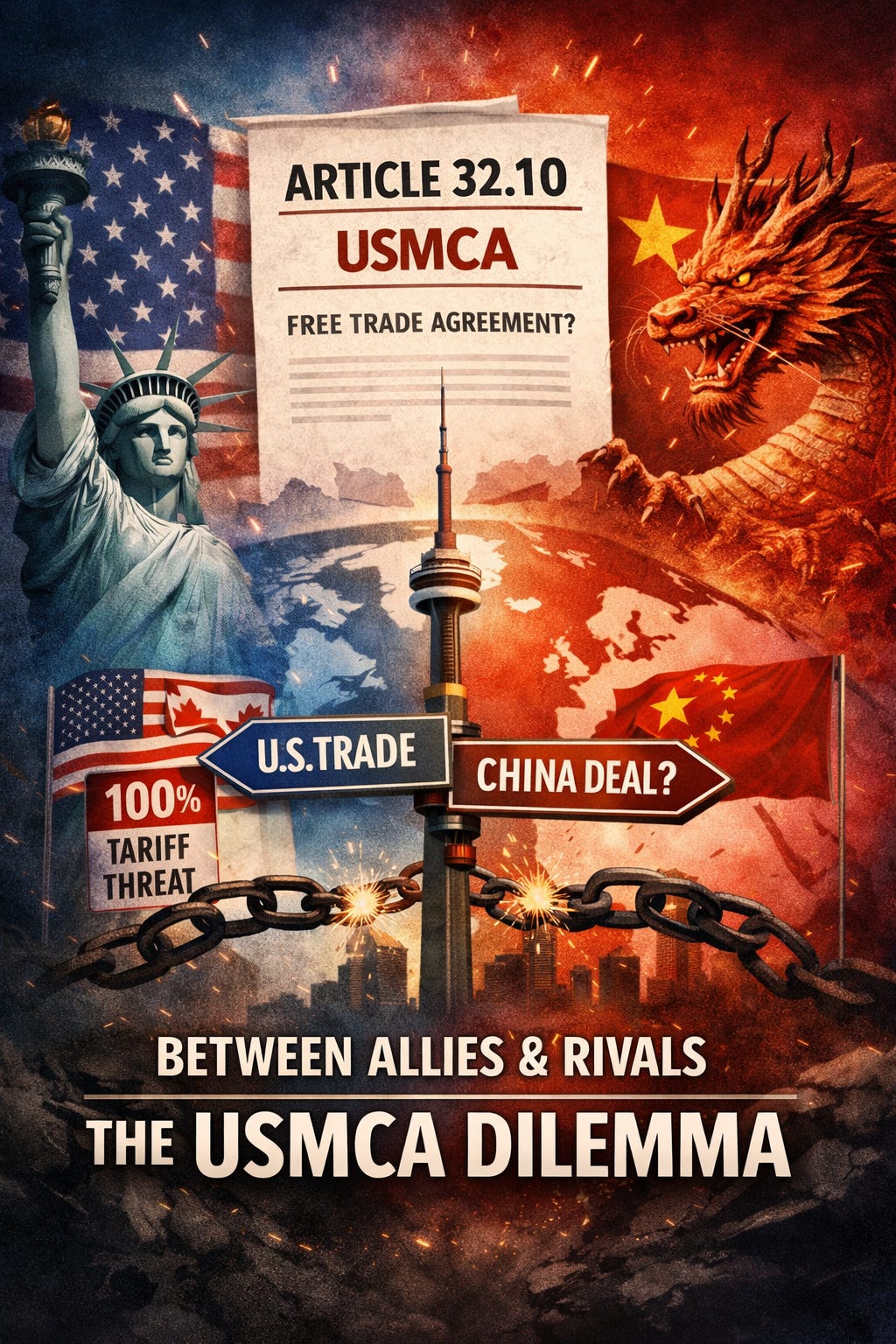
The United States respects countries that can say no. It pays little weight to those who must say yes. — This week, Canada proved it cannot.
President Trump threatened 100% tariffs on all Canadian goods. Within hours, Ottawa retreated. In the words of Britney Spears - Oops – we did it again.
U.S.-Canada Trade Minister LeBlanc is now assuring Washington there is “no pursuit” of a free trade deal with China.1 The trade reset arrangement Prime Minister Carney announced last week—canola access for Chinese EVs—has been quietly reframed as mere “tariff relief.” The Davos speech warning of a “rupture” in the American-led order? Already forgotten.
This was predictable. It was avoidable. And it reveals exactly what John Ruffolo and Jim Balsillie warned us about: Canada lacks the structural capacity to say no.2
When Eloquence Meets Reality
As I warned in The Limits of Eloquence just days ago: diagnosis is not treatment. And eloquence, in statecraft, is not strategy.
Prime Minister Carney crossed the Rubicon twice in one week—and then waded back.
First, the China arrangement was announced without apparent regard for CUSMA’s notification requirements under Article 32.10,3 the definitional trap Canada walked into—and the legal exposure it created—deserves closer examination. That CUSMA provision requires Canada to notify the United States three months before commencing negotiations with a non-market economy. If Washington dislikes the deal, it can terminate CUSMA entirely and replace it with a bilateral U.S.-Mexico agreement.
This is not a hypothetical lever. It is a loaded gun—and we handed them the ammunition.
Then came Davos, where Carney rebuked American leadership before a global audience. John Holmes, the dean of Canadian diplomacy, titled his classic collection of essays The Better Part of Valour—invoking Shakespeare’s Falstaff, who reminded us that “the better part of valour is discretion.” Holmes understood that effective diplomacy between unequal powers requires knowing not only what to say, but when and where to say it.
Washington responded with an ultimatum: the 100% tariff threat.
And Canada blinked.
The China deal is now a non-deal. The assertive posture is now “focused on ensuring the future of that relationship will benefit workers and businesses on both sides of our border.” We have traded defiance for deference—again.
This is not statecraft. It is improvisation without leverage. You cannot make grand gestures on Monday and capitulate on Saturday. It signals to Washington that Canada will fold under pressure—every time. And it is worse when Canada confirms the U.S. suspicion by effectively capitulating time and time again.
The China Deal: A Definitional Trap of Canada’s own Making
Canada’s defence of the China arrangement rests on a single claim: it was not a “free trade agreement” requiring advance notification under Article 32.10 of CUSMA. Minister LeBlanc insists there is “no pursuit of a free trade deal with China”—merely “tariff relief” on canola, lobster, crabs, and peas in exchange for limited Chinese EV access. But now, as a trade lawyer, I need to read the CUSMA and consult international trade law. Canada’s defence is legally fragile and strategically reckless.
The definitional void is the trap. Article 32.10 requires Canada to notify the United States three months before “commencing free trade agreement negotiations with a non-market country.” But here is the problem Ottawa appears to have ignored: CUSMA does not define “free trade agreement.”
There is no definition in CUSMA Chapter 1 (Initial Provisions). None in Chapter 32 (Exceptions and General Provisions). None in any annex or interpretive note. The term is simply assumed, and that silence is legally significant.4
Under the Vienna Convention on the Law of Treaties, undefined terms are interpreted according to their ordinary meaning, context, and relevant rules of international law.5 The WTO provides functional criteria: an FTA must cover “substantially all trade,” eliminate duties and restrictive regulations, and do so within a reasonable timeframe. 6 But WTO practice also recognizes that an FTA is identified by structure and effect—not by what the parties choose to call it.
This ambiguity was not an oversight. It was a feature.
Article 32.10 was designed to give the United States maximum interpretive leverage. Under a broad reading—which Washington is entirely entitled to assert—any agreement that reduces tariffs, creates preferential market access, or includes sectoral trade disciplines could trigger the provision. A “tariff relief” arrangement covering agricultural commodities and electric vehicles fits comfortably within that definition.
Canada’s semantic distinction between a “free trade deal” and “tariff relief” is precisely the kind of legalistic hair-splitting that invites American retaliation. The absence of a safe harbour in the treaty text means Canada cannot unilaterally declare itself compliant. That determination belongs to the aggrieved party—and Washington has already rendered its verdict.
The question is not what Canada intended. The question is what Article 32.10 permits the United States to claim.
Secretary Lutnick’s dismissal of the China pivot as grounds to reconsider CUSMA was not bluster. It was a signal that the United States views the arrangement as triggering its termination rights under Article 32.10—regardless of how Ottawa characterizes it.7
And Canada took no steps to protect itself.
If the government knew it was planning both the China announcement and the Davos speech—both certain to provoke Washington—prudent statecraft would have demanded prior consultation, legal positioning, or at a minimum a strategy for managing the American response. Instead, Canada made grand gestures on Monday and capitulated on Saturday.
This is not a government that misread Article 32.10. It looks more like a government that failed to read it at all.
The Mexico Contrast
Consider Mexico. President Sheinbaum maintains extensive Chinese trade ties. Mexican manufacturing is deeply integrated with Chinese supply chains. Yet Mexico has not drawn the same ire—nor faced the same ultimatum.
Why? Because Mexico has managed the relationship quietly, professionally, and without public grandstanding. Even now, Sheinbaum called Carney’s Davos speech “very good”—a diplomatic gesture of solidarity that cost her nothing while we pay the price.8
As I observed in The Limits of Eloquence: while Canada was making declarations in Davos, Mexico was scheduling meetings in Washington. Canada won accolades from Europeans. Mexico has continued to obtain better economic terms from the United States.
Sovereignty is not measured by speeches. It is measured by your capacity to protect your national interests.
Canada provoked a confrontation it could not sustain. Canada made a grand gesture (getting standing ovations in Davos) that we could not back. We backed down on the Digital Services Tax, and we did it again on China. The lesson Washington draws is simple: pressure works.
The Three Tests: Sovereignty, Prosperity, Agency
In Sovereignty, Prosperity, Agency, I proposed a framework for evaluating any policy choice Canada faces: three tests that apply across domains—digital policy, trade negotiations, and security arrangements.
This week’s capitulation fails all three.
Sovereignty: Who decides? When Canada announces a China arrangement and retracts it within days under American pressure, the answer is clear—Washington decides. We have surrendered the authority to determine the final outcome of our trade relationships.
Prosperity: What kind of economy are we building? An economy that cannot diversify—that must accept whatever terms Washington offers—is an economy permanently dependent on American goodwill. That is not prosperity. It is precarity.
Agency: Can Canada still say no? This week proved we cannot. If you can’t say no, you’re not negotiating. You’re complying.
Jim Balsillie warned in 2019 that CUSMA would put Canada “on a path of becoming Puerto Rico without a passport.” Today, we are proving him right—not through annexation, but through capitulation.9
We lack the institutional capacity to negotiate from a position of strength. We lack the economic diversification to absorb pressure. We lack the legislative tools to impose consequences. Even when we have legal capacity in the treaties to push back, we have failed to do so. And so, each and every time, we back down to bullying.
This week’s retreat is not an isolated failure. It is a symptom of chronic under-preparedness.
What Canada Must Do Now
Canada—the game is not over—but it is time we played the real game that is afoot. There is hope for Canada - but it takes preparation and focus now. And we seem to be squandering both.
The next confrontation will come. Article 34 of USMCA allows Washington to terminate the treaty with six months’ notice.10 Section 32.10 allows the U.S. to blame Canada for the China deal and cancel the treaty on that basis with six months’ notice. The 2026 review is approaching. Canada must build the capacity we failed to develop in the last three decades—before the next ultimatum arrives.
1. Establish a Canadian Trade Advisory System
The United States deploys hundreds of security-cleared private sector advisors through its Industry Trade Advisory Committees.11 These advisors hold Secret-level security clearances and have access to confidential trade negotiating documents. Almost 1,000 experts are available to U.S. authorities in real-time during trade negotiations.
Canada once had an analogous system: the Sectoral Advisory Groups on International Trade (SAGITs). These bodies were dismantled. As I noted in The Limits of Eloquence: the U.S. has nearly 1,000 experts on call for trade negotiations—Canada has none. We bring consultations to trade negotiations where our counterparts bring scalpels and extended real-time networks.
And let’s end the smugness. Canada has existing reservations and exceptions in treaties, but we refuse to use those powers that we actually have, simply because of moral superiority. We want to look better than our neighbours. There is no answer to the thousands of out-of-work steel, aluminum, lumber, and auto sector workers. If Canada has the power, we need the focus to use it, to protect Canadian jobs and sovereignty.
We got outgunned in the CUSMA negotiations because we lacked institutional capacity. Build it now—before the 2026 review.
2. Pass a Sovereign Economy Act
Canada needs legislative authority to defend critical sectors from foreign economic coercion—whether from the United States or China. This should include safeguards for supply chains, critical minerals, digital infrastructure, and strategic industries. We need to appoint a trade tsar inside government to get a whole-of-government response to these trade threats and to better connect with the private sector and civil society.
The Act should authorize countermeasures when our trading partners act in bad faith:
Mirror tariffs calibrated to match foreign aggression
Procurement restrictions targeting offending jurisdictions
Asset freezes for systematic treaty violations
3. Prioritize Value-Added Production and Import Substitution
We cannot remain an economy that exports basic commodities and re-imports manufactured goods at a markup. Canada must develop domestic manufacturing capacity in sectors where we currently depend on imports—starting with pharmaceuticals, semiconductors, and defence procurement.
4. Retain Canadian IP in Canada
Our publicly funded research institutions generate valuable intellectual property that migrates to foreign corporations.12 R&D-funded firms must retain IP and operations in Canada for a decade. Innovations developed with public funds must create Canadian jobs and Canadian wealth.
5. Assert Digital Sovereignty
On data governance, AI regulation, data privacy and stablecoins, Canada must act like a nation—not a client state. Establish Canadian data residency requirements for sensitive government operations. Create a digital infrastructure strategy that does not depend on Silicon Valley platforms. Focus immediately on infrastructure that creates real sovereign compute for critical government data. Support Canadian companies in creating IP and innovation that stays in Canada. Create a made-in-Canada policy so we know how to negotiate the upcoming deal – otherwise it will be dictated to us, by foreign industry or foreign powers.
6. Diversify Trade—But Quietly
We are late to this game. We need to strengthen ties with the EU, UK, Japan, South Korea, and CPTPP partners. But do it professionally, systematically, and without the grandstanding that invites American retaliation. Mexico has shown that this is possible. Skip the standing ovation and get the job done, effectively and quietly.
The Hard Truth
This week, Canada demonstrated—again—that we are the leveraged party. We made threats we could not keep. We drew lines we could not hold. Washington learned that a single ultimatum is enough to bring Ottawa to heel.
Resilience is not rhetoric. It is readiness. Canada had neither this week.
The framework I proposed in Sovereignty, Prosperity, Agency remains the test:
If you can’t say who decides, you’ve already lost sovereignty. If you’re renting capacity instead of building it, you’ve already lost prosperity. If you can’t walk away from a bad deal, you’ve already lost agency.
The next test is coming. The 2026 CUSMA review. Article 34 notice. Another tariff ultimatum. The question is whether we will build the capacity to respond—or whether we will retreat again.
Nations that cannot imagine coercion are rarely ready to resist it. This week, we imagined it, provoked it, and then surrendered to it.
Canada can do better. But first, we must stop making it worse—and start building the capacity to hold the line.
Thanks for reading! If this resonates with you, feel free to share it.
Related Posts:
• The Limits of Eloquence: Canada’s Davos Moment and the CUSMA Reckoning
• Sovereignty, Prosperity, Agency: The Real Tests for Canadian Policy
© 2026 Barry Appleton. All rights reserved.
Catherine Lévesque, “Liberals assure Trump: ‘no pursuit’ of free trade with China, after 100% tariff threat,” National Post, January 24, 2026.
This Substack arises from John Ruffalo’s engaging and provocative January 25, 2026 LinkedIn post. John Ruffolo, LinkedIn post, January 2026, https://www.linkedin.com/posts/joruffolo_jan-2-the-liberals-2019-plus-other-letters-activity-7421203648120274944-cKuy. Ruffolo is Founder of Maverix Private Equity and Co-Founder of the Council of Canadian Innovators.
Article 32.10 of CUSMA states: “At least 3 months prior to commencing negotiations, a Party shall inform the other Parties of its intention to commence free trade agreement negotiations with a non-market country.”
The term “free trade agreement” appears in Article 32.10 without definition. This contrasts with other key terms that are explicitly defined in CUSMA Article 1.5.
Vienna Convention on the Law of Treaties, Art. 31(1): "A treaty shall be interpreted in good faith in accordance with the ordinary meaning to be given to the terms of the treaty in their context and in the light of its object and purpose."
GATT Article XXIV:8(b) defines a free-trade area as "a group of two or more customs territories in which the duties and other restrictive regulations of commerce... are eliminated on substantially all the trade between the constituent territories." See also GATS Article V for service.
Commerce Secretary Howard Lutnick, speaking at Davos on January 22, 2026, explicitly linked Canada’s China arrangement to the upcoming CUSMA renegotiation: “Do you think the president of the United States is going to say you should keep having the second-best deal in the world” if Canada imports Chinese electric vehicles? See Chris Anstey, “Lutnick Rejects Canada’s China Tilt, Sees Summer USMCA Talks,” Bloomberg, January 22, 2026.
“Carney’s Davos speech was ‘very good,’ Mexico’s president Sheinbaum says,” National Post, January 2026.
Jim Balsillie’s warnings about CUSMA’s digital concessions date to 2018-2019. He characterized Canada’s negotiating posture as a “colonial supplicant attitude.” See “Balsillie sounds alarm on USMCA’s impact on data in Canada,” BNN Bloomberg, October 12, 2018. Balsillie sounds alarm on USMCA’s impact on data in Canada. Balsillie’s January 2, 2019, letter to the Editor can be found at: Jim Balsillie, “The Liberals’ 2019,” letter to the editor, The Globe and Mail, January 2, 2019, https://www.theglobeandmail.com/opinion/letters/article-jan-2-readers-share-their-thoughts-on-the-federal-liberals-and/.
Article 34.6 of CUSMA provides that “A Party may withdraw from this Agreement by providing written notice of withdrawal to the other Parties. A withdrawal shall take effect six months after a Party provides written notice.”
The United States maintains fifteen Industry Trade Advisory Committees (ITACs). All ITAC members must hold a Department of Commerce security clearance at the Secret level. See U.S. Department of Commerce, ITAC Operations Manual. See also Barry Appleton, “A Sovereign Advisory System for Canada: Rebuilding Strategic Foresight in Trade and Innovation” (CIGI Sovereign Canada Initiative, October 7, 2025). Available at SSRN: http://dx.doi.org/10.2139/ssrn.5575590
Balsillie: “We take things that are unambiguously ours and give them away… We’re basically playing Bangalore or Ukraine, where they basically say ‘we’re cheap, skilled labour.’” See “Former BlackBerry CEO Balsillie calls on IMF to set standards for data usage,” The Globe and Mail, November 21, 2018.
What nonsense. There is no comprehensive trade deal, just an agreement to return to the way tariffs once were. No blinking. No capitulation.
Carney made a small, opening deal with China, and was just forced to reassure Trump it was not a “free trade deal”. Nothing in the deal changed. How is that blinking?
And, hey: since the deal with China remains on and unchanged, I guess there will not be 100% tariffs, no?
Unless Trump blinks. Like he did on Greenland, in a few hours flat.