
The Triple Crisis: Why Canada Needs a Cold-Blooded Strategy Before July's CUSMA Review
The CUSMA/USMCA review, provincial separatist backchannels, and the Arctic security pincer demand strategic clarity—not emotional posturing

The Triple Crisis: Why Canada Needs a Cold-Blooded Strategy Before July
The CUSMA/USMCA review, provincial separatist backchannels, and the Arctic security pincer demand strategic clarity—not emotional posturing
Barry Appleton | February 1, 2026 Appleton’s Clause & Effect | Substack
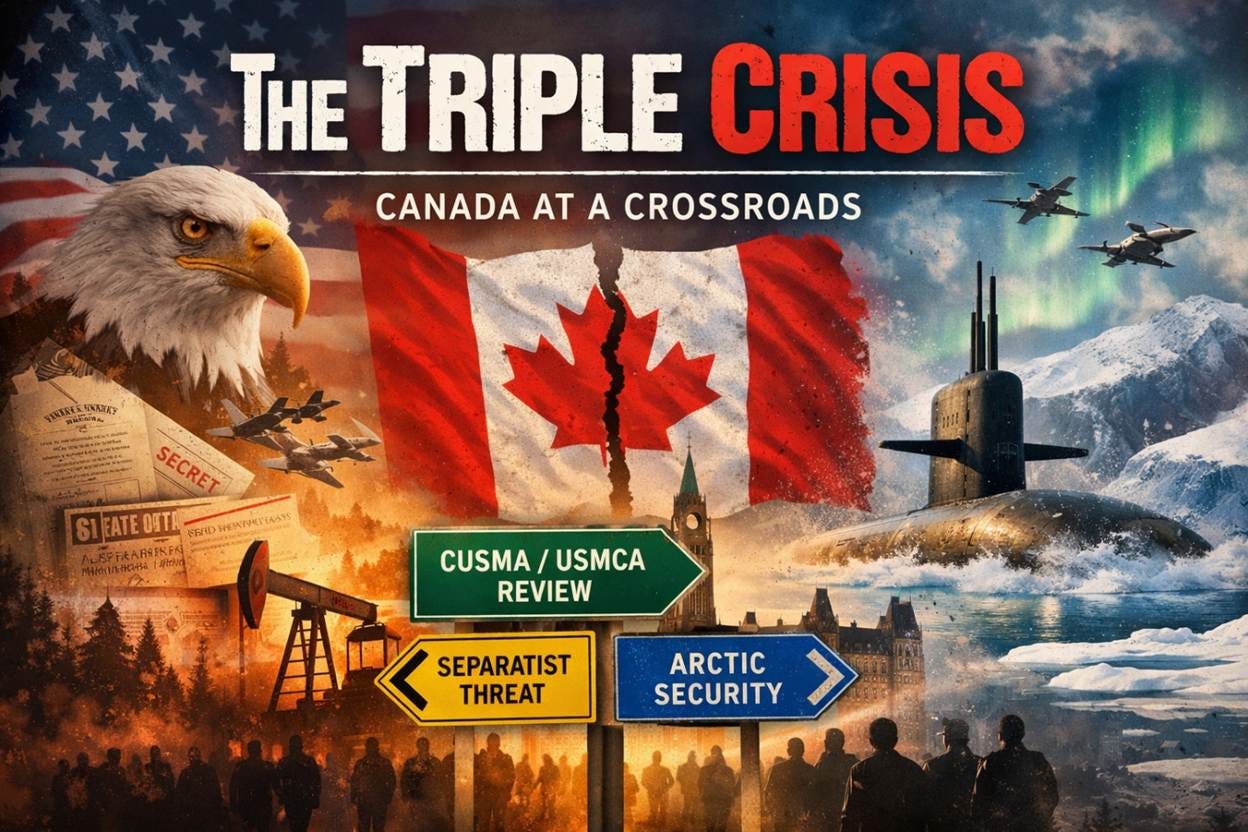
In international trade, there is a fundamental rule: never show a weak hand to a neighbor who owns the casino. Prime Minister Mark Carney has spent January 2026 violating it on two fronts simultaneously.
On the tangible side, his “Pacific Pivot” has triggered CUSMA’s Article 32.10 Poison Pill by flirting with Chinese EVs and command-economy steel.1 On the intangible side, the government’s $52.5-billion bet on foreign-headquartered battery plants is textbook branch-plant economics—subsidizing Canada’s own obsolescence while the intellectual property walks out the door.2
Meanwhile, the Americans are actively probing the structural integrity of the Canadian Confederation itself. State Department officials meeting with Alberta separatists.3 The “Golden Dome” Arctic defense strategy treats the Northwest Passage as a bargaining chip.4 A CUSMA review deadline in July that Washington intends to use as a guillotine.
This is Canada’s triple crisis. And the air in Ottawa is thick with two things that have no place in trade negotiations: emotion and nostalgia.
Game theorists would recognize Canada's position immediately: a repeated game with an asymmetric payoff structure, where the stronger player can credibly threaten defection while the weaker player cannot. In such games, the rational strategy is not tit-for-tat retaliation—it is to change the structure of the game itself. First, Canada must understand the game and then it needs to pivot to the right strategy. Canada must shift from a bilateral negotiation it cannot win, to a multilateral framework where it holds cards that Washington needs.
The Donroe Doctrine
Call it what it is: a twenty-first-century Monroe Doctrine of total hemispheric consolidation. From the capture of Maduro in Venezuela to the predatory interest in Greenland, the U.S. National Security Strategy now treats the Arctic as its defensive shield, the hemisphere as fundamentally an extension of the United States, and North American integration as non-negotiable.
The State Department’s meetings with Alberta Prosperity Project organizers are not an emotional slight. They are tactical fragmentation—classic divide-and-rule.
By courting factions in the province that provides the tangible energy America still requires, Washington signals it can bypass Ottawa entirely if the federal government refuses to align with the “North American Fortress.”
But let Canada be equally cold-blooded: Alberta’s flirtation with Washington is a fool’s errand.
In a rentier system (a fancy word for a tenant economy), the U.S. doesn’t want Alberta as a partner; it wants Alberta as a tributary. A fragmented Canada simply makes extraction cheaper.
Quebec’s Miscalculation
The recent curtailment of Hydro-Québec exports to New England during the January polar vortex was officially attributed to reliability issues.5 The timing was impeccable. It was a visceral reminder to the U.S. Northeast that its green transition runs on a Canadian plug.
But weaponizing energy is dangerous when you operate on a 1% reserve margin. It invites Washington to classify our utilities as national security threats—justifying the very annexation rhetoric now echoing through the MAGA caucus. Ask Ontario’s Doug Ford how well electricity brinkmanship worked when he threatened to cut power to three American states last year. The answer came in the form of immediate and unequivocal tariff escalation, not U.S. capitulation.
The Branch-Plant Trap
Carney’s industrial strategy compounds the problem. As Jim Balsillie has warned, Canada is not equipped to compete in what he calls the ‘complex, predatory and state-sponsored ideas ownership game.’6 In the intangible economy, 90% of S&P 500 market value is now driven by intellectual property and data.”7
By funding foreign branch plants, we aren’t innovating—we are subsidizing factories that can be shuttered the moment a cheaper jurisdiction appears.
Canada pays foreign titans to build on our soil, yet we do not own the patents, the data, or the AI systems that make those batteries valuable. When the IP leaves, the high-paying management jobs and the tax base follow. Canada, by unfortunate design, is left with low-value assembly—and a massive bill for the privilege.
Countries today, as Balsillie notes, “predatorily govern the spillover.” Canada’s AI legislation died in Parliament last year. We have no legal framework to anchor intangible value at home.
We are sleepwalking into a rentier trap—a tenant economy that collects rent for its resources while foreigners in Washington and Beijing capture all the real value. It’s time to wake up.
The Snap Election Trap
Carney’s poll numbers are strong—his approval sits above 50 percent in most surveys. Calling a snap election would still be a strategic blunder.8 If he triggers a campaign to secure a majority, he invites Washington to drop the tariff hammer mid-race—tanking the TSX and proving he cannot manage the relationship.
The Americans would love nothing more than to pick Canada’s next government. Arguably, they picked the last one.
Consider the alternative. Pierre Poilievre’s “Canada First” doctrine—reinforced by his 87% leadership review victory in Calgary—is not the soft touch Washington might expect. Poilievre has no interest in Davos multilateralism. He is talking about a Canadian Sovereignty Act and an Economic Fortress. If Carney is a globalist the Americans dislike, Poilievre is a sovereigntist they might fear.
But neither man’s poll numbers matter.
The only metric that counts is: Who owns the code, and who controls the data? It’s the new intangibles economy that really counts for future prosperity. Silicon Valley gets this, Trump too.
Strategic Indispensability: A Three-Pillar Response
Canada faces four possible futures in its U.S. relationship: Integrated Partner (alignment with autonomy), Subordinate Ally (alignment without autonomy), Defiant Competitor (autonomy without alignment), or Failed State (neither). Only the first is acceptable. The question is which path leads there—and the answer is not defiance.
I advised during the original NAFTA negotiations and in disputes thereafter. The lesson from that era remains true: Canada's leverage has never come from threats, but from making ourselves indispensable to outcomes America already wants.
Canada cannot bluff its way out of what was, until recently, 75% dependence on U.S. exports.9 We must pivot from Defiant Diversification to Strategic Indispensability—making ourselves too valuable to coerce.
This can result in some difficult choices. International trade negotiators sometimes must give up what they most want in exchange for what they can get. Perhaps this is the most challenging part of the job.
First, align on China. CUSMA’s Article 32.10 poison pill is not a suggestion. Canada must immediately pause the EV quota and synchronize its China tariff schedule with Washington. Yes – this infringes on Canadian trade sovereignty – but this removes the “Trojan Horse” pretext that justifies American retaliation. It is not capitulation; it is triage. We preserve the relationship to fight on the ground of our choosing. This is a key factor for every military commander – it’s time Canada started to think tactically in its strategy.
Second, trade some voice in the Arctic for trade peace. The U.S. wants a Joint Arctic Command and a Golden Dome missile shield. Instead of resisting on emotional grounds, we should treat this as our primary lever. We secure the North—but only in exchange for a permanent, legislatively mandated immunity from Section 232 tariffs.10 Let the Americans pay for the icebreakers while we retain transit rights and preserve CUSMA. Remember, we share our Arctic anyway with the U.S. because of Alaska. This is not the answer I want, but it is the right answer for thousands of auto, steel, aluminum, and lumber workers.
Third, legislate digital sovereignty. While the EU has enacted comprehensive frameworks governing AI, data, and digital platforms, Canada’s proposed legislation died in Parliament—leaving us without binding rules to keep Canadian-owned data and algorithms under Canadian control.11 Canada must establish a framework to govern Canadian-owned AI compute and data. This includes regulating stablecoins and digital payment systems—the infrastructure of tomorrow's commerce. Without a domestic framework, Canada cedes rule-making authority to Washington and Brussels by default. Every federal subsidy dollar must be tied to Canadian ownership of the resulting intellectual property. If the U.S. wants our critical minerals for their industrial war with China, the price is not just a trade exemption—it is recognition of a Canadian-governed digital ecosystem. It’s time to stop subsidizing foreign IP. Build national capacity in Canada.
Remember - the next decade's trade disputes will not be fought over steel—they will be fought over stablecoin regulation, digital payment rails, AI, and who controls the infrastructure of cross-border commerce. Canada cannot afford to be a rule-taker. We need to keep a seat at the table - and that only happens when you are making the rules, not taking them.
The Binary Choice
There are no friends in the 2026 global economy. There are only interests.
The July CUSMA review is not just about trade. It is about whether Canada remains a sovereign architect of its own future or becomes a resource-rich tenant on its own land—governed by the algorithms of others, paying rent to foreign platforms, and watching our federation tested by a neighbor who has decided that hemispheric consolidation is the price of security.
This moment calls for the kind of cold-blooded calculation that built Carney’s reputation in central banking—not the reactive posturing that has characterized Ottawa’s early response to the tariff threat. The Prime Minister comes to the office with the credibility and the intellectual toolkit to execute a strategic pivot. Whether he chooses leverage over symbolism will determine Canada’s position for a generation
The choice is binary. The deadline is July. The call is coming from inside the continent.
———
Barry Appleton is Co-Director of the Center for International Law at New York Law School, Managing Partner of Appleton & Associates International Lawyers LP, and a Fellow at the Balsillie School of International Affairs. He served as an advisor during the original NAFTA negotiations.
.
United States-Mexico-Canada Agreement, Art. 32.10, July 1, 2020. [This document is known as USMCA in the U.S, - CUSMA in Canada]. The provision requires notification and consultation before entering free trade agreements with “non-market” economies, effectively giving the U.S. veto power over Canadian trade negotiations with China. This is a self-judging determination made by any Treaty Party that justifies the termination of the CUSMA. The difference between the poison pill and the other termination clause in Article 34 is that the poison pill allows a party to name, shame, and blame another treaty party, while ordinary termination simply ends the treaty. See USTR, https://ustr.gov/trade-agreements/free-trade-agreements/united-states-mexico-canada-agreement
The PBO estimates total government support could reach $52.5 billion. Parliamentary Budget Officer, “Costing Support for EV Battery Manufacturing,” November 17, 2023, https://www.pbo-dpb.ca/en/publications/RP-2324-015-P. Total support could reach $52.5 billion, with $31.4 billion federal and $21.1 billion provincial.
Financial Times, January 29, 2026. See also Catharine Tunney, “B.C. premier says Alberta separatists seeking assistance from U.S. is ‘treason,’” CBC News, January 29, 2026, https://www.cbc.ca/news/politics/eby-alberta-separatism-9.7066320.
Executive Order 14186, “Defending the United States from Aerial Attack,” January 27, 2025. See Congressional Research Service, “Defense Primer: The Golden Dome for America,” IF13115, https://www.congress.gov/crs-product/IF13115 . On the Arctic dimension, see CBS News, “What is the ‘Golden Dome’?” May 21, 2025.
During the January 24-26, 2026 polar vortex, Hydro-Quebec suspended electricity deliveries to Massachusetts to meet domestic demand. See David Abel, “New power line provided little juice to New England during Sunday’s storm,” Boston Globe, January 26, 2026; Canadian Press, “Extreme cold disrupts Hydro-Quebec exports to Massachusetts,” January 30, 2026.
Jim Balsillie, “Canadians Can Innovate, but We’re Not Equipped to Win,” Globe and Mail, May 8, 2015, https://www.theglobeandmail.com/report-on-business/rob-commentary/balsillie-learns-canadian-innovators-not-equipped-for-global-competition/article24346408 . See also Jim Balsillie, keynote address, 4th Annual IP Data & Research Conference, Centre for International Governance Innovation, https://www.cigionline.org/multimedia/prosperity-security-canadas-ip-imperative-featuring-jim-balsillie.
Ocean Tomo, “Intangible Asset Market Value Study,” 2020, https://oceantomo.com/intangible-asset-market-value-study. Intangible assets constituted 90% of S&P 500 market value as of 2020, up from 17% in 1975.
Abacus Data, “Prime Minister Carney’s Standing Improves as Liberals Strengthen Ahead of Conservative Convention,” January 29, 2026, https://abacusdata.ca/prime-minister-carney-approval-liberals-strengthen-ahead-conservative-convention . Carney’s net favorable reached +23, with 53% positive impressions. Liaison Strategies polling from the same week showed approval at 62%. Conservative Leader Pierre Poilievre Wins Leadership Review with 87.4% Approval,” CBC News, January 31, 2026, https://www.cbc.ca/news/politics/conservative-poilievre-leadership-review-9.7069573.
Statistics Canada, “Canadian International Merchandise Trade.” In 2024, the U.S. share of Canadian exports averaged 75.9%; by late 2025, this declined to approximately 67-68% amid trade diversification. See Global Affairs Canada, “Monthly trade report: 2025.
Section 232 of the Trade Expansion Act of 1962, 19 U.S.C. § 1862, authorizes the President to impose tariffs on imports deemed threats to national security. See Congressional Research Service, “Section 232 Investigations: Overview and Issues for Congress,” updated September 2025, https://crsreports.congress.gov/produc
Canada’s Artificial Intelligence and Data Act (AIDA) failed to pass when Parliament dissolved in January 2025. See Osler, Hoskin & Harcourt LLP, “Canada’s 2026 Privacy Priorities: Data Sovereignty, Open Banking and AI,” December 17, 2025, https://www.osler.com/en/insights/reports/2025-legal-outlook/canadas-2026-privacy-priorities-data-sovereignty-open-banking-and-ai/. For EU frameworks, see European Commission, Digital Strategy, https://digital-strategy.ec.europa.eu/