
Reciprocal in Name Only
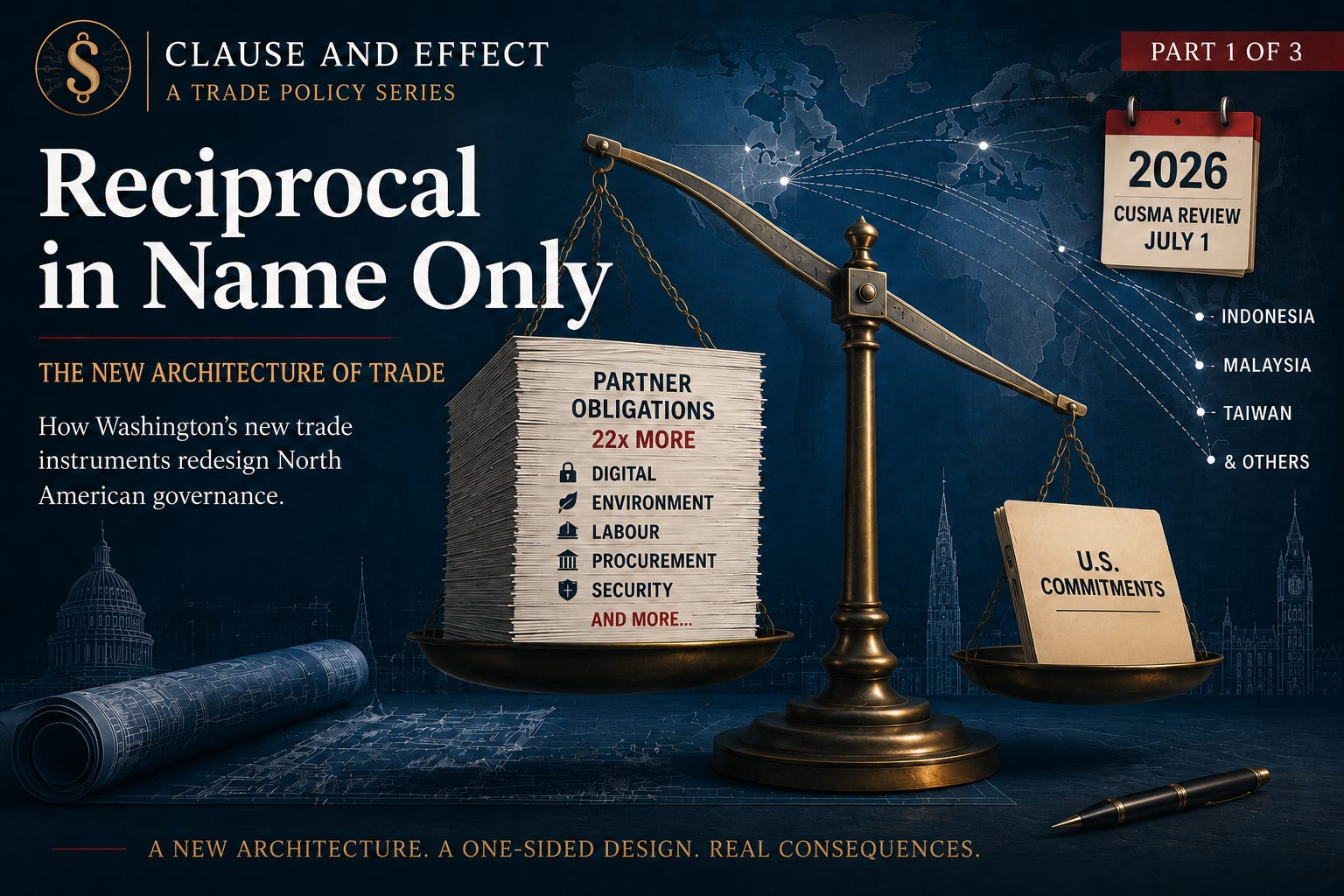
The ratio that tells you everything: 'Indonesia shall,' 200 times. 'United States shall,' nine

Appleton’s CLAUSE AND EFFECT Substack
Barry Appleton · June 6, 2026 · Part 1 of 3
For eighty years, trade agreements came with a congressional mandate. The Agreements on Reciprocal Trade do not. Nine have been signed. More are coming. Here is what they are, and what they are about to ask of North America.
The United States led the world trading system by opening its trade negotiations with a congressional mandate and closing them with a legislative vote. That architecture has been set aside. The instrument that has replaced it is called an Agreement on Reciprocal Trade. In the one the United States signed with Indonesia in February, the phrase “Indonesia shall” appears more than 200 times across 45 pages[1] “The requirement that the United States shall” appears only nine.[2] That ratio, roughly twenty-two to one, is not a drafting accident. It is the design.
In the Indonesia agreement, “Indonesia shall” appears more than two hundred times. “United States shall” appears nine.
Nine Agreements on Reciprocal Trade have been signed, with Argentina, Bangladesh, Cambodia, Ecuador, El Salvador, Guatemala, Indonesia, Malaysia, and Taiwan. More are in negotiation. They are the template the United States is bringing to the renegotiation of its agreement with Canada and Mexico, whose first formal joint review opens on July 1. Before that template arrives at the North American table, it is worth understanding what it is and how it got here, because the departure from eighty years of practice is not a technical adjustment. It is a strategic choice.
The foundation that was set aside
The modern American trade architecture was built as a response to failure. Congress, acting alone on tariff-setting in the Smoot-Hawley Tariff of 1930, triggered the deepest collapse of international trade in the nation’s history.[3] President Roosevelt’s answer was structural. The Reciprocal Trade Agreements Act of 1934, drafted by Secretary of State Cordell Hull and renewed by Congress every few years, delegated the tariff-negotiating authority to the executive on the condition that Congress stayed in the room: it set the objectives, renewed the mandate, and received the results.[4] That discipline produced the GATT in 1947, the Kennedy and Tokyo Rounds, and eventually the World Trade Organization. For each major agreement, Congress was the anchor.
The instrument that formalized this for the modern era is Trade Promotion Authority, better known as Fast Track or TPA. Under TPA, both houses of Congress pre-authorize the executive to negotiate an agreement on defined objectives, with a commitment that the result will receive an up-or-down vote without amendment. Congress gave that authority for NAFTA, for the Uruguay Round and the WTO, and for the United States-Mexico-Canada Agreement (USMCA- CUSMA). Trade Promotion Authority under the Bipartisan Congressional Trade Priorities and Accountability Act of 2015 expired on July 1, 2021. It has not been renewed. Any conventional renegotiation of the USMCA/CUSMA would require new legislation. The administration has not asked for it.[5]
The constitutional structure running beneath TPA is not merely statutory. The power to regulate commerce with foreign nations is assigned to Congress by Article I. Treaties require two-thirds of the Senate. The entire apparatus of postwar trade law was a carefully engineered delegation: Congress retained the authority and deliberately chose to share it with the executive under specified conditions. When TPA lapsed, so did the delegation. What has followed is not a new delegation. It is an assertion that no delegation is required.
Year 1 of the second Trump administration put that assertion under pressure from every direction. The administration invoked the International Emergency Economic Powers Act to impose sweeping tariffs. The Supreme Court held, in a 6-3 ruling on February 20, that IEEPA does not authorize tariffs.[6] The administration then invoked the balance-of-payments authority in Section 122 of the Trade Act, and the Court of International Trade struck those tariffs as well, though a stay keeps collection running while the appeal proceeds. Section 122 authority expires July 24. Meanwhile, the administration was negotiating bilateral agreements with trading partners and showing no interest in congressional approval.
US Trade Representative Greer, testifying before the Senate Appropriations Committee, stated that the administration would not seek congressional approval for its new trade deals unless they change current law.[7] Senator Wyden, the ranking Democrat on the Finance Committee, responded in writing that Greer had refused to commit to submit the agreements to Congress, and quoted Georgetown’s Kathleen Claussen: “The Constitution is clear: Article I assigns foreign commerce power to Congress. The executive branch does not have independent authority to enter into trade agreements that create binding commitments for the United States.”[8] Those concerns are bipartisan. Multiple senators have raised the consultation deficit.
I described the opening of this era in August 2025, when the US-EU Framework Agreement came down. In “From Tariffs to Transmissions” (Clause and Effect, August 21, 2025), I argued it was the opening salvo of what I called the Trump Round: bilateral agreements and digital ambition rather than Geneva rounds and congressional authority. What has happened since has confirmed and accelerated that analysis. The Agreements on Reciprocal Trade were formalized in the Trump Round.
The courts closed one door. The legislature was not asked to open another. Instead, the administration walked through a window.
The legal question of where the ARTs’ authority now comes from, given the IEEPA ruling and the expiry of Section 122 authority on July 24, is the subject of the companion Appleton Substack piece in this series, “Settled Out of Congress,” publishing shortly. This piece concerns the instrument itself.
Where the template came from
The sequence is short. On April 2, 2025, the administration imposed the “reciprocal” country-by-country tariffs it called Liberation Day.[9] In September, an executive order built the machinery to negotiate them away one country at a time and stated the logic plainly: the President’s willingness to reduce the reciprocal tariff depends on the scope and economic value of the partner’s commitments.[10] The tariff is the stick. Relief is the carrot. The ART is the form the bargain takes.
Indonesia is the worked example. Indonesia agreed to eliminate roughly ninety-nine percent of its tariffs on American goods, to accept American product standards and certifications, to drop taxes on American digital services and duties on electronic transmissions, and to purchase American energy, agricultural goods, and aircraft. In return, the United States agreed to lower the reciprocal tariff on Indonesian goods to nineteen percent.[11] Read the two sides of that exchange. The partner’s concessions are written into its law and its regulatory practice. The American concession is a tariff number set by executive order and can be adjusted again by executive order.
The partner’s concessions are permanent and structural. The American concession is a tariff number that can move again.
What is actually in them
The agreements are not mainly about tariffs. A close reading of the nine texts shows seven recurring mechanisms.[12]
The partner agrees to prohibit imports made with forced labour and, in most texts, to act on American determinations under American law.
The partner agrees to adopt measures of “equivalent restrictive effect” whenever the United States restricts trade with a third country on economic or security grounds.
The partner agrees to act against firms in its own market owned or controlled by third countries.
The partner agrees to align its export controls with American lists, and in Taiwan’s case, with the American Foreign Direct Product Rule.
The partner agrees to screen inbound and sometimes outbound investments for security risks.
The partner agrees to tighten its rules of origin against transshipment.
And the partner accepts a penalty clause: if it falls out of compliance, or signs the wrong agreement with the wrong country, the United States may terminate the deal and reimpose the reciprocal tariff.
The clause that gives the game away is the one requiring “equivalent restrictive effect.” An agreement nominally about bilateral commerce reaches past the border and into the partner’s policy toward third countries. It does not merely lower a tariff. It exports American policy choices into another country’s law and asks that country to enforce them.
These are not mainly agreements about tariffs. They are agreements about what the smaller party will do.
Why “reciprocal” is the wrong word
Reciprocity in trade has a precise meaning. It describes a mutual exchange of substantially equivalent concessions, and under the foundational rule of the postwar system, the most-favoured-nation obligation in Article I of the GATT, concessions granted to one partner are extended to all.[13] The Agreements on Reciprocal Trade invert both halves of that idea. The concessions are not equivalent; they run overwhelmingly in one direction. And the rates are conditional and partner-specific, which is the opposite of most-favoured-nation treatment.
None of this means the United States gains nothing. The U.S.gains a great deal: market access for its exporters, realignment of supply chains away from a strategic rival, and the alignment of partner economies with American security choices. A policymaker in Washington can defend each of those objectives on its own terms, and many will. But the label is doing work the text does not support.
Calling the instrument “reciprocal” describes the handshake, not the bargain.
Reciprocity once meant balanced concessions extended to all. It now means the United States names the terms, and the partner signs.
How it is playing out in North America
This is the template now arriving at the North American table.
The USMCA-CUSMA joint review opens on July 1 under Article 34.7 of the Agreement.[14] It is not arriving cold. The United States has already begun bilateral negotiating rounds with Mexico: a first round in Mexico City on May 28 and 29, on economic security and rules of origin for industrial goods, and a second in Washington on June 16 and 17, covering agriculture and what the parties call a level playing field.[15] Mexico has taken what one analysis describes as a “clear the decks” approach, moving in advance on a list of American concerns that includes foreign investment screening and labour enforcement, the same subjects that fill the Agreements on Reciprocal Trade.[16] The United States has also signaled its intent to extend rules of origin beyond automobiles to other industrial goods, and the Trade Representative has said that a rubber-stamp extension of the Agreement is not in the national interest.[17]
Canada, for its part, has written to its partners seeking a sixteen-year renewal and asking for parallel talks on sectoral tariffs, and it was not in the room for the first bilateral rounds between the United States and Mexico.[18]
Watch the structure, not only the substance. A trilateral agreement is being worked on as a stack of bilaterals. In a three-party agreement, a smaller party has room to maneuver among competing interests. In a bilateral, it faces the larger party alone. The ART template is bilateral by nature and bringing it to North America converts one three-way agreement into two two-way negotiations, each conducted on the template’s terms. The two systems are already linked: the forced-labour tariff action announced this month makes a commitment through an Agreement on Reciprocal Trade a qualifying route to the lower tariff tier, placing the ART inside the same tariff machinery that now bears on Canada and Mexico.[19]
I have analyzed the five scenarios facing Canada under this USMCA review in No Going Back, and the strategic positions Canada can claim before July 1 in Know Your Ground. The argument in The Exits Exist is that the options remain open if Canada moves now. What the ART template means is that the instrument matters as much as the outcome: an obligation accepted inside a ratified treaty binds all three legislatures symmetrically; an obligation accepted inside a bilateral ART beside the treaty binds only the party that signs.[20]
As I noted in “Canada After the Shuffle” and “Four Capitals, Four Readings,” the deck has been reshuffled, but Canada is holding more structural ground than it is using.
The template was built for countries that had no choice. It is arriving at the table of a country with more structural ground than it is using.
Why this should concern Washington too
The asymmetry is not only a problem for the smaller party. It is a problem for the deal’s durability, and that is an American problem.
International law has names for the difficulty. A treaty is binding, the principle of pacta sunt servanda. But a party may seek release when the circumstances that produced its consent change fundamentally, the principle of rebus sic stantibus. Both are codified in the Vienna Convention on the Law of Treaties.[21] An agreement extracted under tariff pressure hands the partner that second argument the day the pressure lifts. The Congressional Research Service has made the same point domestically: because these agreements were not approved by Congress, they are arguably less durable than those that were, and they may invite legal challenges or retrospective conditions.[22]
The deeper cost is to the system the United States built. The postwar order rewarded predictability and non-discrimination for a reason: predictability lowers the cost of capital for everyone who trades, American firms included. Instruments that are asymmetric, conditional, and revocable raise that cost. A partner that surrenders regulatory autonomy under duress has every incentive to walk it back when it can. That is not speculation. When the United States left the Trans-Pacific Partnership, the eleven remaining parties suspended twenty-two provisions, almost all of them American priorities, the moment the pressure was gone.[23]
An agreement that binds one party is not a contract. It is a position, held only as long as the pressure that produced it.
Read the text, not the title
The Agreements on Reciprocal Trade are not a footnote to the current trade moment. It is increasingly clear that they are its template. North America is about to be measured against it, in a joint review that opens in weeks and in bilateral rounds that have already begun. Canada and Mexico should read the text before they are asked to sign anything that resembles it, and should notice, on the first page, that the word “reciprocal” describes a hope rather than the document beneath it.
There is a second question underneath all of this, and it is a legal one. Now that the Supreme Court has struck the emergency tariffs and the balance-of-payments tariffs are before the courts, where does the authority for this whole architecture come from? That is the subject of the companion piece “Settled Out of Congress,” published Monday. This one is about the instrument itself. Read the text, not the title.
Prof. Barry Appleton is Managing Partner of Appleton & Associates International Lawyers LP, Co-Director of the Center for International Law at New York Law School, and Interim Director of the Balsillie Legal Advisory Centre at the Balsillie School of International Affairs. This is Part 1 of a three-part series. Part 2, “Already in Motion,” publishes tomorrow. Part 3, “Settled Out of Congress,” publishes Monday.
© 2026 Barry Appleton. All rights reserved.
[1]Agreement Between the United States of America and the Republic of Indonesia on Reciprocal Trade (signed Feb. 2026), https://ustr.gov/sites/default/files/files/Press/Releases/2026/02.19.26%20US-IDN%20ART%20Full%20Agreement%20-%20US%20Final%20for%20Website%20sanitized.pdf (primary text, containing the obligations described and the commitment that “Indonesia shall adopt or maintain a measure with equivalent restrictive effect” when the United States restricts trade with a third country).
[2]The New Deal: Anatomy of the U.S.’s New Reciprocal Trade Agreements in Southeast Asia, Lexology (May 2026) (reporting that in the Indonesia ART “Indonesia shall” appears more than 200 times across 45 pages while “United States shall” appears nine times, a 22-to-1 ratio; and that per USTR fact sheets Cambodia eliminated tariffs on 100 percent of U.S. goods, Indonesia on more than 99 percent, and Thailand on 99 percent, with Malaysia and Vietnam committing to preferential market access).
[3]Tariff Act of 1930 (Smoot-Hawley), Pub. L. No. 71-361, 46 Stat. 590 (U.S. imports fell approximately 66 percent between 1929 and 1932; retaliatory foreign tariffs reduced U.S. exports by similar magnitudes).
[4]Reciprocal Trade Agreements Act of 1934, Pub. L. No. 73-316, 48 Stat. 943 (codified as amended at 19 U.S.C. § 1351) (authorizing the President to negotiate bilateral trade agreements and proclaim tariff reductions of up to 50 percent without subsequent congressional approval, subject to periodic renewal by Congress).
[5]Bipartisan Congressional Trade Priorities and Accountability Act of 2015, Pub. L. No. 114-26, 129 Stat. 319 (codified at 19 U.S.C. § 4202) (Trade Promotion Authority expired July 1, 2021 and has not been renewed; the Constitution’s treaty power under Article II, section 2, clause 2 requires two-thirds Senate approval for formal treaties, while the postwar practice of congressional-executive trade agreements required affirmative votes in both houses through TPA procedures).
[6]Learning Resources, Inc. v. Trump, 607 U.S. ___ (2026) (decided Feb. 20, 2026) (holding that IEEPA does not authorize the President to impose tariffs); the implications are analyzed in “Settled Out of Congress,” published today as Part 2 of this series.
[7]USTR Greer Says More Trade Deals Are Coming, Lexology (Dec. 2025) (reporting on Ambassador Greer’s Senate Appropriations Committee testimony, in which Greer stated that the administration would not seek congressional approval for its new trade deals unless the agreements change current law).
[8]Senate Committee on Finance, Wyden to USTR: Congress Must Approve Binding Trade Deals (July 2, 2025), https://www.finance.senate.gov/ranking-members-news/wyden-to-ustr-congress-must-approve-binding-trade-deals (quoting Senator Wyden that Greer “refused to commit to submit new trade deals for Congressional approval,” and quoting Professor Kathleen Claussen, Georgetown University Law Center, that “the executive branch does not have independent authority to enter into trade agreements that create binding commitments for the United States”).
[9]Exec. Order No. 14257, Regulating Imports With a Reciprocal Tariff to Rectify Trade Practices That Contribute to Large and Persistent Annual United States Goods Trade Deficits, 90 Fed. Reg. 15,041 (Apr. 2, 2025).
[10]Exec. Order No. 14346, Modifying the Scope of Reciprocal Tariffs and Establishing Procedures for Implementing Trade and Security Agreements, 90 Fed. Reg. 43,737 (Sept. 10, 2025) (providing that the President’s willingness to reduce reciprocal tariffs depends in part on the scope and economic value of the partner’s commitments in its Agreement on Reciprocal Trade).
[11]The White House, Joint Statement on Framework for United States-Indonesia Agreement on Reciprocal Trade (July 2025), (Indonesia to eliminate approximately 99 percent of tariff barriers; United States to reduce the reciprocal tariff to 19 percent; rules of origin to ensure benefits accrue primarily to the United States and Indonesia).
[12]Mary E. Lovely & Christine Y. Wan, US Reciprocal Trade Deals Built to Push America’s Trade Partners Away from China, Peterson Inst. for Int’l Econ., RealTime Economics (June 4, 2026), (identifying seven recurring exclusionary mechanisms across the nine signed agreements: forced-labour import exclusions, coordinated restrictions on third-country trade, provisions on third-country-controlled firms, export-control alignment, investment security screening, rules of origin, and penalty clauses; documenting nine signatories as of May 22, 2026).
[13] General Agreement on Tariffs and Trade art. I, Oct. 30, 1947, 55 U.N.T.S. 194 (the most-favoured-nation obligation requiring that advantages granted to products of any country be extended to like products of all other contracting parties).
[14] Canada-United States-Mexico Agreement art. 34.7 (providing for a joint review on the sixth anniversary of entry into force, at which each party confirms whether it wishes the Agreement to continue).
[15]Office of the U.S. Trade Representative, The United States and Mexico Announce Series of Bilateral Negotiating Rounds Related to the First Joint Review of the USMCA (May 2026) (first round in Mexico City May 28-29 on economic security and rules of origin; second round in Washington June 16-17 on agriculture and a level playing field); Office of the U.S. Trade Representative, The United States and Mexico Conclude First Bilateral Round Related to the Joint Review of the USMCA (May 2026).
[16] Chicago Council on Global Affairs, The USMCA Review: What to Keep in Mind and What to Watch for on North American Trade (Mar. 2026) (reporting Mexico’s “clear the decks” approach and U.S. interest in extending rules of origin to non-automotive industrial goods).
[17] Congressional Research Service, USMCA Joint Review: Process and Role of Congress, R48787 (2026) (quoting USTR Greer that “the shortcomings [of USMCA] are such that a rubberstamp of the Agreement is not in the national interest”).
[18] Canada Seeking 16-Year USMCA Renewal, Sector Tariff Discussions in Trade Talks, Reuters (June 3, 2026).
[19] Office of the U.S. Trade Representative, USTR Makes Findings and Proposes Action in 60 Section 301 Investigations Relating to Failures to Take Action on Trade in Forced Labor Goods (June 2026),(proposing a lower 10% tier for economies with a forced-labour import prohibition, an ART commitment, or a partial regime).
[20]Barry Appleton, No Going Back: Five Scenarios for the 2026 USMCA-CUSMA Joint Review, SSRN Working Paper No. 6570764 (revised Apr. 30, 2026), https://ssrn.com/abstract=6570764 ; Barry Appleton, Know Your Ground: Canada’s Strategic Red Lines for the 2026 CUSMA Joint Review, SSRN Working Paper No. 6643319 (revised Apr. 30, 2026), https://ssrn.com/abstract=6643319; Barry Appleton, The Exits Exist: Canada’s Strategic Case for the 2026 CUSMA Review, SSRN Working Paper No. 6491461 (2026), https://ssrn.com/abstract=6491461 .
[21]Vienna Convention on the Law of Treaties arts. 26, 62, May 23, 1969, 1155 U.N.T.S. 331 (art. 26, pacta sunt servanda; art. 62, fundamental change of circumstances). The United States is not a party to the Convention but regards much of it as reflecting customary international law.
[22]Congressional Research Service, Section 301 Investigation: Forced Labor and Import Policies of U.S. Trading Partners, IN12672 (updated Mar. 2026) (observing that agreements entered into without congressional approval could arguably be less legally and politically durable than congressionally approved agreements such as USMCA and may be subject to legal challenge or retrospective congressional conditions).
[23]Comprehensive and Progressive Agreement for Trans-Pacific Partnership, Mar. 8, 2018, in force Dec. 30, 2018 (suspending twenty-two provisions of the original Trans-Pacific Partnership following U.S. withdrawal).