
Canada After the Shuffle
The May 7 Tariff Ruling, the Technology Dominance Agenda, and the Joint Review Risk Map

Barry Appleton | Clause and Effect | May 8, 2026
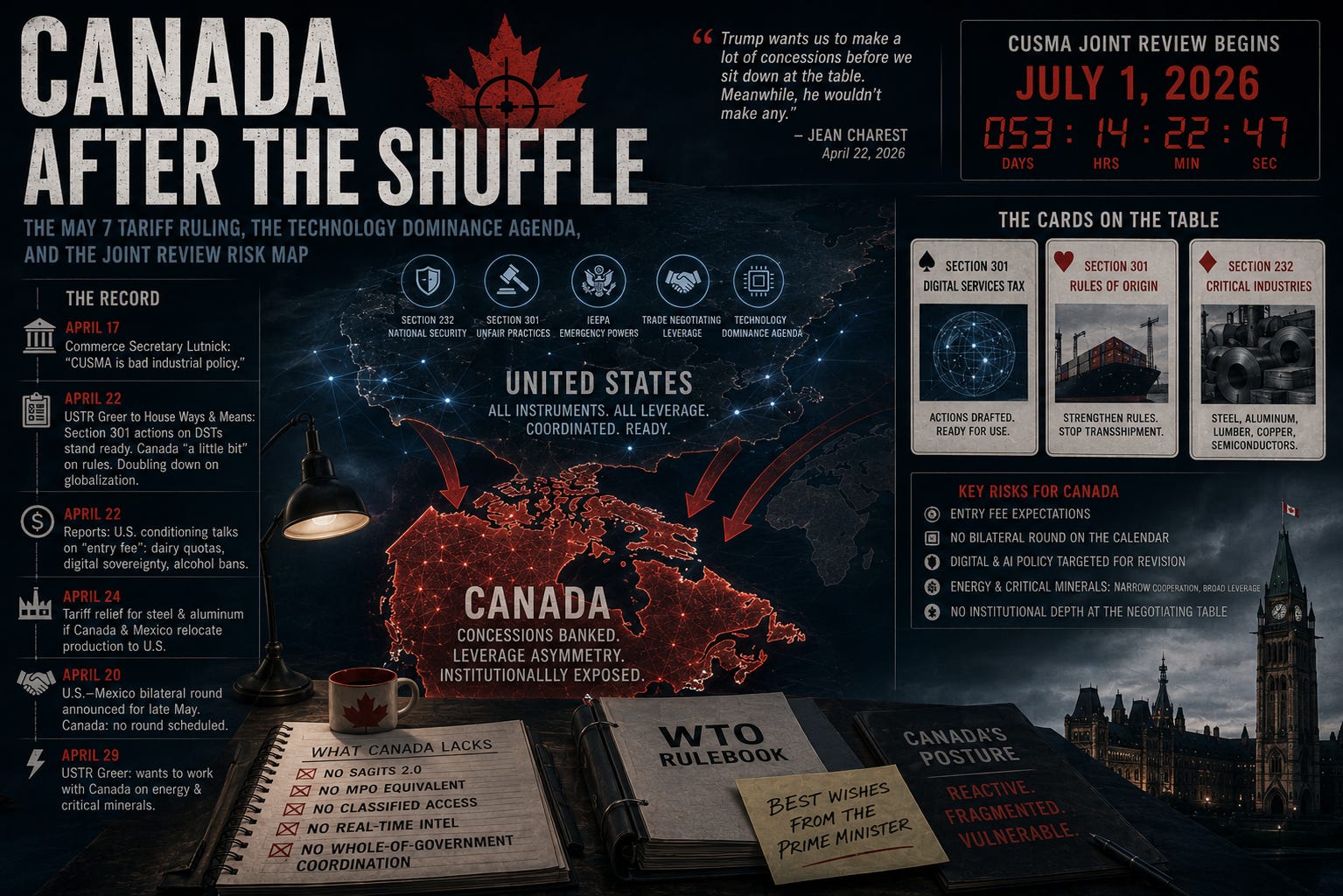
The Court of International Trade’s May 7 ruling against the Section 122 surcharge produces different readings in different capitals. Earlier in my previous Four Capitals, Four Readings substack, I walked through how Beijing, Mexico City, and Brussels read it. Ottawa’s reading deserves its own treatment because the Canadian situation differs in kind from the others.1
Canada was the principal beneficiary of the discarded Section 122 exemption. Canada is the only major United States trading partner that has been publicly differentiated from a peer (Mexico) by the administration’s senior trade representative. Canada is the subject of two distinct, named Section 301 instruments at varying stages of readiness. And Canada is the only major trading partner whose digital, AI, and innovation policies have been identified, in the administration’s own strategic documents, as objects of explicit revision through trade negotiations.
The May 7 ruling did not change any of this. It clarified which cards the administration will play in the run-up to the July 1 Joint Review opening, and it accelerated the timeline on each of them. This piece walks through what those cards are and what is on each of them.
I. The Record of Demands
The administration’s posture toward Canada is documented in public statements over April 2026 with unusual clarity.
On April 17, 2026, Commerce Secretary Howard Lutnick characterized CUSMA as “bad industrial policy” requiring reconsideration. On April 22, 2026, USTR Greer testified to the House Ways and Means Committee that Section 301 actions targeting digital services taxes had been drafted and stand ready for use, that the United States had reached agreements with nine other countries prohibiting DSTs, and that the administration was particularly focused on strengthening rules of origin to prevent third-country transshipment. Asked whether Canada was “playing by the rules,” Greer answered “a little bit” on steel, but pointed to Prime Minister Carney’s trade diversification efforts as the principal problem. His conclusion was direct: Canada was “doubling down on globalization when we’re trying to correct for the problems of globalization. So those are two models that don’t fit together very well.”2
The same day, CBC News and Radio-Canada reported, on the basis of four sources, that the administration was conditioning formal CUSMA talks on upfront Canadian concessions, described by three of those sources as an “entry fee.” The specific demands were dairy quota administration, digital sovereignty policy, and provincial alcohol bans. Jean Charest, named to Prime Minister Carney’s new advisory committee on the same day, confirmed the framing publicly: “Trump wants us to make a lot of concessions before we sit down at the table. Meanwhile, he wouldn’t make any.”3
On April 24, 2026, the administration extended the same logic to Canadian and Mexican steel and aluminum producers, offering immediate tariff relief conditional on relocating production to the United States. Canada-United States sectoral talks have been suspended since fall 2025. Prime Minister Carney has characterized the sectoral tariffs as a CUSMA violation.4
On April 20, 2026, USTR Greer met Mexican President Claudia Sheinbaum and the two governments announced the first formal United States-Mexico bilateral CUSMA negotiating round for late May. As of April 28, 2026, Canada had no equivalent round scheduled.5 5
On April 29, 2026, USTR Greer indicated at a Wall Street Journal event that the United States wishes to work with Canada on energy and critical minerals. That cooperative signal converged with Prime Minister Carney’s late-April statements that Canada will not “leverage” energy or critical minerals in trade talks.6
The picture is mixed. The principal trend is hostile. The cooperative signal in the energy and critical minerals sectors is real but narrow. The Joint Review begins July 1, 2026, with that mix of signals as the entering condition.
There is also a Canadian self-inflicted dimension. Canada has already paid twice in this round of trade tension without securing reciprocal United States concessions: the retaliatory tariff rollback in spring 2025 and the digital services tax repeal in June 2025 each produced no movement from Washington. The administration’s posture, in operational terms, has been to bank Canadian concessions and seek the next ones. The Section 122 ruling does not reset this dynamic.7
II. What the May 7 Ruling Changes for Canada
The Section 122 ruling does not alter the administration’s stated demands. It changes the legal architecture through which those demands can be enforced.
Before May 7, the administration had a Section 122 surcharge in place that exempted CUSMA-qualifying Canadian goods, with a statutory expiry on July 24, 2026. The exemption produced a kind of accidental shelter. As long as Canadian goods qualified under CUSMA rules of origin, the 10 percent surcharge did not apply. The exemption did not protect Canada from the existing Section 232 architecture, which already imposes 25 to 50 percent rates on Canadian steel, aluminum, copper, lumber, and advanced semiconductors. But it did protect Canada from the marginal global rate.
After May 7, the Section 122 surcharge is halted only as to three named plaintiffs and is statutorily set to expire on July 24 in any event. The Canada exemption is meaningless because there is no surcharge to be exempt from.
What replaces the exemption is the multi-instrument toolkit the administration has been preparing throughout 2025 and 2026. Three of those instruments are aimed specifically at Canadian targets.
First: Section 301 actions on digital services taxes. The administration has these drafted and ready, per Greer’s April 22 testimony. Canada repealed its digital services tax in June 2025 under prior United States pressure, but the policy area remains active because the underlying digital trade dispute extends well beyond the specific tax. The administration’s broader objective is to prevent any trading partner from imposing fiscal or regulatory measures on United States technology platforms. Canada’s Online Streaming Act and Online News Act have been described by United States business witnesses at the December 2025 USTR hearings as discriminatory measures requiring repeal under USMCA nondiscrimination provisions. These laws are obvious next targets if Section 301 actions are deployed.8
Second: Section 301 investigation on Canadian labour practices. This was initiated in March 2026 and is the first Section 301 investigation against Canada in the modern era. It can produce country-specific tariffs on Canadian goods independent of any other instrument. The investigation timeline runs roughly twelve months from initiation, but interim measures and findings of unreasonableness are available on shorter timelines.99
Third: Section 232 investigations on pharmaceuticals, critical minerals, commercial aircraft, medium and heavy-duty trucks, drones, and robotics. Each investigation can produce a Presidential proclamation imposing tariffs at any time. Each affects significant Canadian export categories. Canada is a major source of United States imports of medium and heavy-duty trucks, a significant source of pharmaceutical inputs, and a source of critical minerals processed using Canadian hydroelectric capacity.
While I have been focused on the majority opinion of Judges Barnett and Kelly, which I find persuasive, there is a dissent. The dissent matters more than its 2-1 vote count suggests. Judge Timothy Stanceu’s thirty-five-page dissent provides the appellate roadmap on three distinct grounds: that the deletion of the H.R. 6767 parenthetical from the Trade Act’s drafting history signaled flexibility rather than confinement to the three 1974 measures the majority identified; that USCIT Rule 56(f) required notice and time to respond before summary judgment could be granted on the specific statutory interpretation theory the majority adopted; and that the Yared Declaration created a genuine factual dispute that should have precluded summary judgment under Rule 56(a). The Federal Circuit reviews each of these grounds de novo. The probability of reversal is meaningfully higher than a typical 2-1 panel decision because the dissent is unusually substantive and the specific procedural objection under Rule 56(f) is the type of error appellate courts correct routinely. The administration’s appeal will combine all three grounds with a stay request under Federal Rule of Appellate Procedure 8 governed by the Nken v. Holder four-factor test. None of this changes Canada’s strategic position. It does extend the period during which the Section 122 surcharge continues to be collected from non-plaintiff importers, which means the immediate cash-register effect of the May 7 ruling is incremental rather than wholesale.
The May 7th ruling creates institutional incentive to accelerate all three of these instruments. The administration has lost its primary horizontal trade pressure tool, which it had been heavily using. Its remaining instruments are sectoral and targeted. The Joint Review window is fifty-five days. Several of the pending Section 232 investigations are expected to conclude before July 1.
III. The Technology Dominance Frame
What ties these instruments together is the administration’s stated strategic objective of maintaining United States technological preeminence.
The November 2025 National Security Strategy makes this objective explicit. The document declares that “maintaining American economic and technological preeminence is the surest way to deter and prevent a large-scale military conflict.” It calls for “preserving and growing America’s financial sector dominance.” It frames the Western Hemisphere as a zone in which the United States must be “preeminent,” including through identification and protection of strategic resources and discouragement of allied collaboration with non-Hemispheric competitors. 10 The January 2025 AI Action Plan reinforces this. The document identifies the American electric grid as facing “historic constraints” from data center and AI infrastructure demand. It states explicitly that “AI is the first digital service in modern life that challenges America to build vastly greater energy generation than we have today” and that “American energy capacity has stagnated since the 1970s.”11
USTR Greer’s December 10, 2025 Atlantic Council remarks pulled the same threads together. He characterized European digital regulation as “trying to set rules for global digital operators” and stated that the United States is “not going to allow that regulation to be outsourced.” The same logic, applied to Canada, identifies any Canadian regulatory architecture that constrains United States technology platforms as an obstacle to United States preeminence rather than as a sovereign domestic policy choice.
Together, these documents identify three strategic priorities: technological preeminence, financial sector dominance, and Hemispheric primacy. Each of these priorities has direct Canadian implications.
On technological preeminence: the administration’s posture is that allied countries should accept United States technology, including artificial intelligence systems, cloud infrastructure, and data architecture, on terms set by the United States. Canadian regulatory measures that constrain United States technology platforms are read in Washington as obstacles to that preeminence.
On financial sector dominance, the administration’s posture is that allied financial systems should not introduce constraints that disadvantage U.S. financial firms. Canadian banking regulation, securities oversight, and pension capital deployment policies all interact with this objective. I note that Toronto is the second-largest financial center in North America.
On Hemispheric primacy: the administration’s posture is that strategic resources in the Western Hemisphere should be allocated to United States priorities. Canadian critical minerals, hydroelectric capacity, and compute infrastructure are explicitly named as strategic resources in this calculus.
The May 7 ruling does not change any of these strategic priorities. It changes the legal vehicles available to enforce them. The shift is from horizontal tariff pressure to targeted sectoral and regulatory instruments. Each of those targeted instruments connects more directly to the technology dominance frame than the Section 122 surcharge ever did.
IV. Digital Trade, AI, and Innovation as Negotiating Objects
The Joint Review is therefore not a goods-and-tariffs negotiation. It is, increasingly, a negotiation about the architecture of technology governance across North America.
Three issues will sit at the heart of the Canadian Joint Review preparation.
Digital trade architecture under Chapter 19. The Chapter 19 disciplines, including the data localization prohibition (Article 19.12), the source code prohibition (Article 19.16), the platform liability provisions (Article 19.17), and the digital products non-discrimination clause (Article 19.4), constrain Canadian regulatory authority over the technology sector in ways that have not been fully tested in practice. The administration is unlikely to seek the removal of these disciplines. The administration is likely to seek expansion of them, and to seek explicit Canadian commitments not to introduce new measures that constrain United States technology firms. The April 22 testimony references nine reciprocal trade agreements that prohibit digital service taxes; the administration will seek similar permanent prohibitions through the Joint Review.
AI and innovation architecture. CUSMA does not currently contain explicit disciplines on artificial intelligence governance. The administration’s stated AI Action Plan objectives suggest that any modernization of CUSMA digital provisions will include AI provisions. The substance of those provisions, particularly around algorithmic transparency, model auditing, training data governance, and AI procurement preferences, will determine how much regulatory authority Canada retains over AI systems deployed in Canadian markets and used by Canadian institutions. Canada has no comparable AI strategy in place. Bill C-27 and the Artificial Intelligence and Data Act framework remain, but no legislation has been passed. The Joint Review will arrive before the Canadian regulatory architecture does.
Innovation and intellectual property architecture. The administration’s posture connects intellectual property protection, technology transfer restrictions, and standard-setting participation. Canadian innovation policy, including federal R&D funding, the Bayh-Dole framework as it applies to publicly funded research, and the patent box and innovation tax credit regimes, all sit at the intersection of these issues. The administration’s National Security Strategy explicitly identifies “long-term U.S. investment” tied to “managed cooperation tied to strategic alignment” as the preferred model for allied economic relationships. The Joint Review provides the legal vehicle through which that alignment will be sought.
Each of these three issue areas is more consequential than any single tariff rate. Each is the operative subject matter of the Joint Review preparation. The May 7 ruling does not change the substance of any of them. The ruling clarifies that the administration’s remaining tariff instruments (Sections 232, 301, 338) and its non-tariff instruments (CFIUS, procurement preferences, export controls) are the principal levers through which technology and innovation outcomes will be pursued.
V. What Canada Should Do
The Canadian response should be calibrated to the actual situation, not to the conventional read of the May 7 ruling.
Do not celebrate the ruling. The ruling does not weaken the administration’s position. Treating it as a Canadian victory misreads the strategic environment and will be received in Washington as evidence that Ottawa has misunderstood the situation. That misreading reduces, rather than enhances, the Canadian negotiating position.
Build the institutional architecture. Sovereign compute, digital governance legislation, an AI regulatory framework, critical minerals export discipline, defence procurement preferences, and a reconstituted SAGIT advisory system are all institutional capacity that exists prior to and independently of any treaty outcome. Each can be advanced significantly within the fifty-five-day window between May 7 and July 1. Canada should arrive at the Joint Review table with that architecture visible.
Coordinate with Mexico. Canada and Mexico are the two CUSMA partners. The administration has been actively differentiating them throughout April 2026. The Canadian counter is to refuse to be split. Joint statements, coordinated negotiating positions, and shared technical analysis on CUSMA architecture are all available instruments. The trilateral nature of CUSMA is a feature Canada should use, not concede.
Engage early on Section 301. The two Section 301 vehicles (DSTs and labour practices) are the most precisely Canada-targetable instruments in the toolkit. Pre-emptive engagement, technical responses to allegations, and structured offers on the underlying policy issues are all more productive than waiting for formal determinations. Canadian counsel has experience with Section 301 disputes from earlier eras and the institutional capacity to engage technically.
Develop a technology and innovation negotiating package. The administration is going to seek expansion of the CUSMA digital trade disciplines. Canada should arrive with a clear position on what is negotiable and what is not, on what reciprocal commitments the administration must offer in exchange, and on what institutional safeguards will be retained. The package should include explicit Canadian positions on AI governance, algorithmic accountability, data residency for critical systems, and source code review for procurement-relevant systems. Canada needs a digital sovereignty policy - and it needs it now. None of these positions can be developed at the table. They must be developed in advance.
Assemble the leverage portfolio. Canadian energy, critical minerals, pension capital deployed in United States assets, agricultural retaliation capacity, and digital market access are all instruments. The administration’s April 29 cooperative signal on energy and critical minerals indicates that there is an audience for a structured Canadian offer in those sectors. The offer should be made in a form that links cooperation in those sectors to broader Canadian regulatory autonomy on digital and innovation issues. The leverage portfolio should not be deployed defensively. It should be presented as the substance of a positive Canadian offer.
VI. The Underlying Logic
The May 7 ruling did not give Canada more time. It gave the administration more reason to act faster.
The deck of legal instruments available to the administration is large. The instrument that most clearly exempted Canadian goods (Section 122) has been removed by the courts. The instruments that target Canadian technology and innovation policy (Section 301, the Section 232 sectoral investigations, and the IEEPA non-tariff toolkit) have not been touched.
The Joint Review is the venue where the administration will press for outcomes that align Canadian technology governance with United States preeminence objectives. That press is not new. The May 7 ruling has just made the timing of that press more compressed and the instruments through which it will be made more sectoral.
Canada should approach the next fifty-five days with the institutional architecture built, the leverage portfolio assembled, and the technology and innovation positions defined.
The shelter for Canada that existed under Section 122 is gone. The case for a structured Joint Review outcome that builds new shelter at the treaty table is now stronger than it was on May 6. The cards on technology, AI, and innovation are the ones now on top of the deck. Canada’s negotiating posture should be designed around those cards.
The exits exist. The leverage is real. The legal architecture has the capacity for structural improvement built into it by the parties who designed it. What remains is the institutional work that must be completed before the treaty table.
Code before clause. The deck has been shuffled. The cards now visible are the cards that always mattered most.
Barry Appleton is Co-Director and Distinguished Senior Fellow at the Center for International Law at New York Law School, Interim Director of the Balsillie Legal Advisory Centre at the Balsillie School of International Affairs and Managing Partner of Appleton & Associates International Lawyers LP. His Substack, Appleton’s Clause and Effect, addresses USMCA architecture, innovation, and Canadian digital and economic sovereignty.
See “Four Capitals, Four Readings: How the May 7 Tariff Ruling Lands in Beijing, Mexico City, Brussels, and Ottawa,” Clause and Effect (May 8, 2026).
Howard Lutnick, U.S. Secretary of Commerce, Remarks at the Semafor World Economy Summit (Apr. 17, 2026), as reported in Bloomberg News; Hearing on the President’s Trade Policy Agenda Before the H. Comm. on Ways and Means, 119th Cong. (Apr. 22, 2026) (testimony of Jamieson Greer, U.S. Trade Representative); Dylan Moroses, USTR Seeking ‘Outcomes’ on DSTs, Stronger USMCA Rules, Law360 (Apr. 22, 2026); BNN Bloomberg, Canada ‘doubling down on globalization’ at odds with U.S. trade goal: Greer (Apr. 22, 2026).
CBC News and Radio-Canada, Washington Demanding ‘Entry Fee’ from Ottawa Before Trade Talks: Sources (Apr. 22, 2026) (four sources confirming pre-negotiation demand on dairy quota administration, digital sovereignty, and provincial alcohol bans; statement of Jean Charest).
CBC News, Trump Offers Immediate Tariff Relief to Aluminum and Steel Companies That Commit to U.S. Expansion (Apr. 24, 2026).
Bloomberg News, Greer-Sheinbaum Meeting Sets Stage for May U.S.-Mexico CUSMA Round (Apr. 20, 2026).
Globe and Mail, reporting on Greer remarks at Wall Street Journal event (Apr. 29, 2026).
The Canadian counter-tariff rollback occurred in spring 2025 in response to United States tariff threats. The Digital Services Tax repeal followed United States pressure in June 2025.
See, e.g., testimony of Christine Bliss, Coalition of Services Industries, Provisional Transcript (Dec. 5, 2025) (welcoming Canada’s withdrawal of its proposed Digital Services Tax while urging USTR to address Canada’s Online Streaming Act); testimony of Jonathan McHale, Computer and Communications Industry Association, Provisional Transcript (Dec. 5, 2025).
Trade Act of 1974, 19 U.S.C. § 2411 (Section 301). The investigation into Canadian labour practices was initiated in March 2026.
The White House, National Security Strategy of the United States of America (Nov. 2025).
The White House, Executive Order on Advancing United States Leadership in Artificial Intelligence Infrastructure (Jan. 2025) [AI Action Plan].